
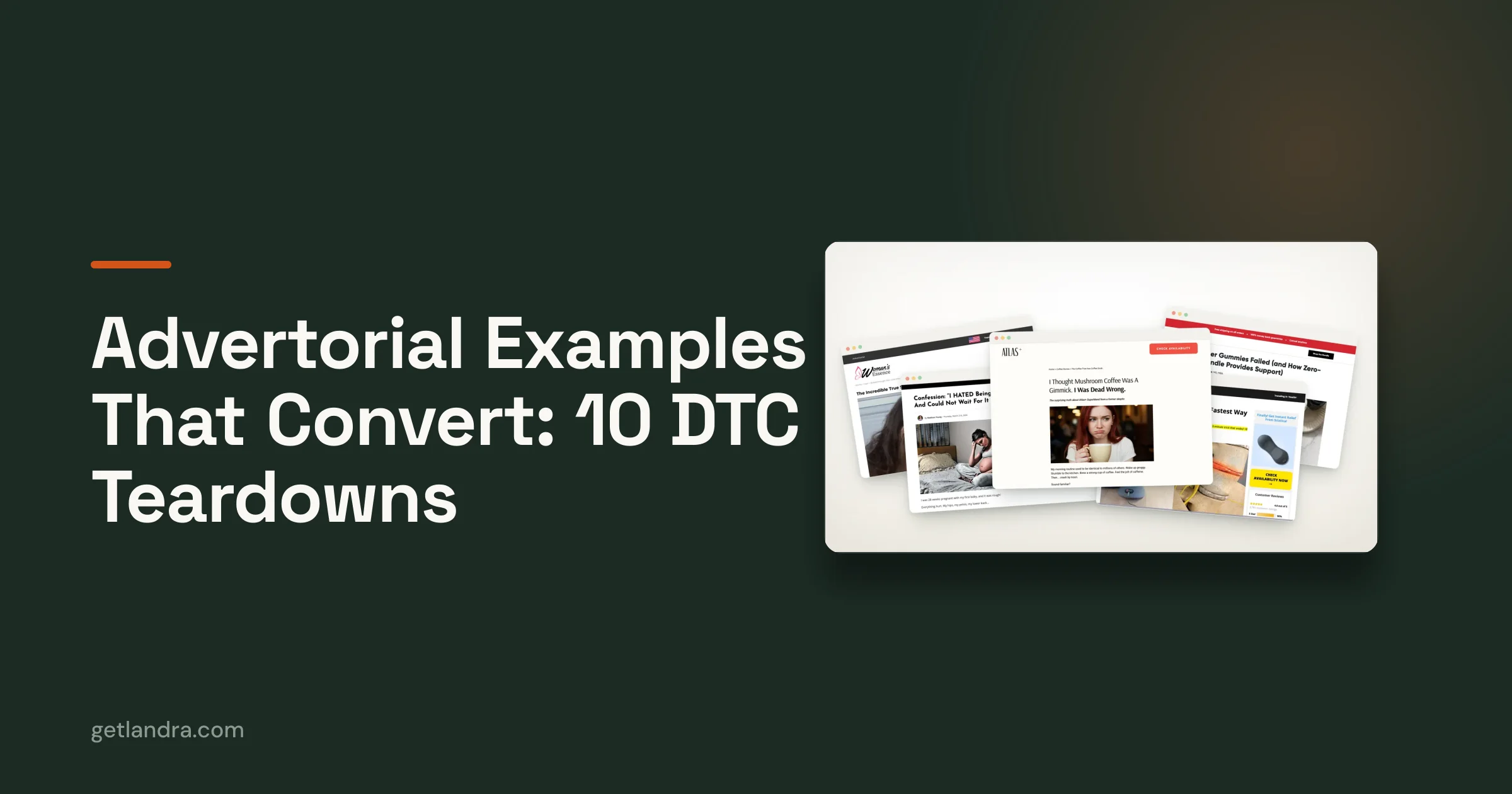
The best way to understand what makes an advertorial convert is to take working ones apart. A true advertorial is a narrative — an editorial-style story, not a numbered list — and below are ten real DTC examples, all live as of June 2026, each broken down for the technique it nails. New to the format? Start with what an advertorial is; ready to write one, see the 5-step framework.
What makes an advertorial convert?
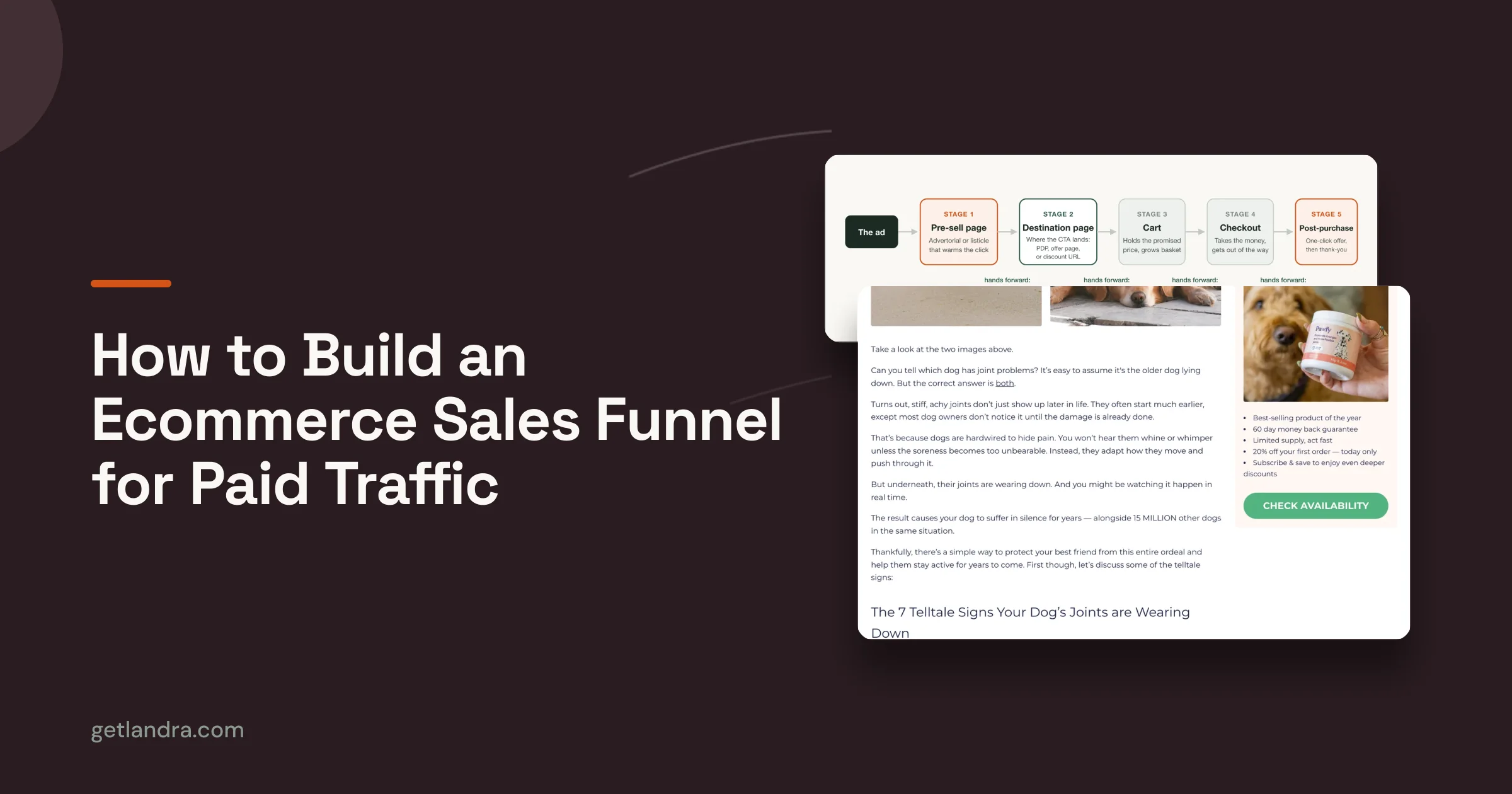
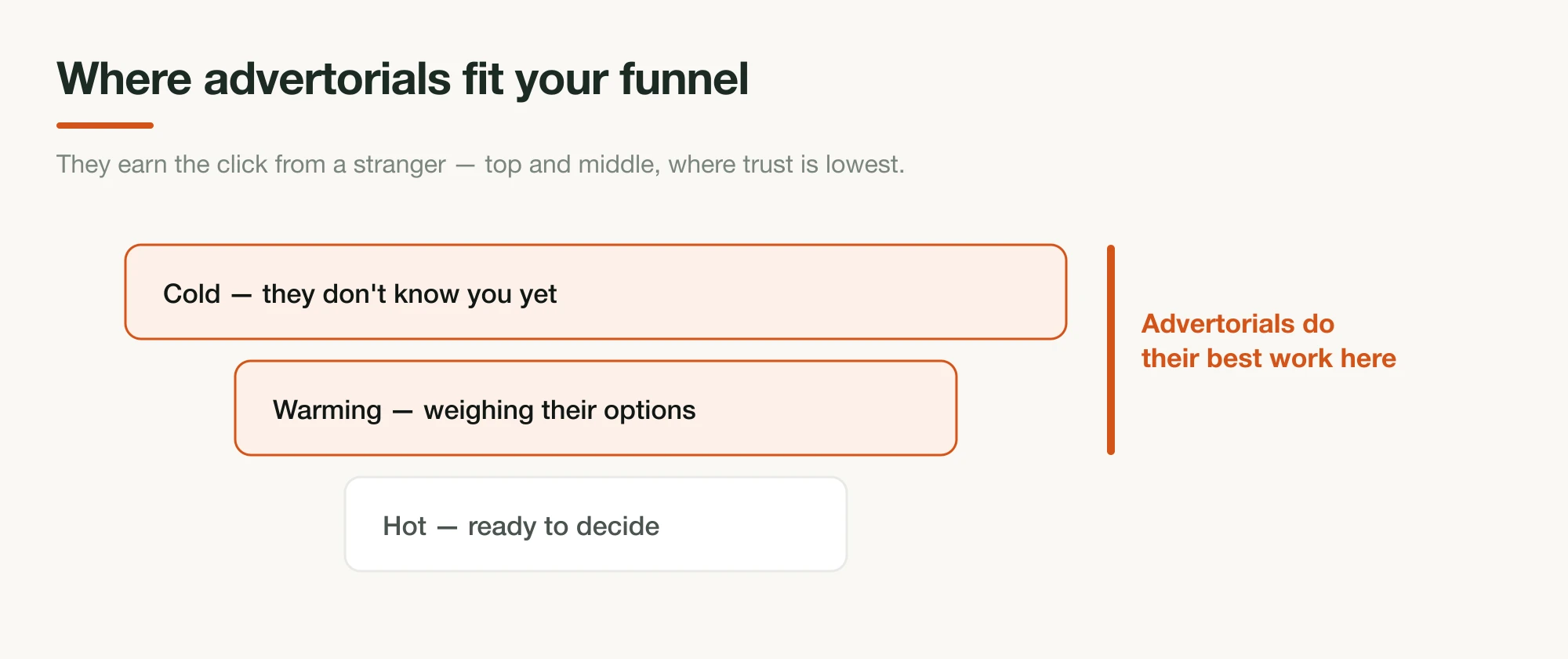
An advertorial converts by earning trust before it asks for the sale. It's an editorial-style pre-sell page — a story or article that reads like content — sent to cold traffic that isn't ready for a product page yet. The mechanism is awareness: most cold paid-social traffic is problem-aware or unaware, and Eugene Schwartz's Breakthrough Advertising framework says you have to meet readers where they are. A product page speaks to the "most aware"; an advertorial walks an earlier-stage reader up to that point.
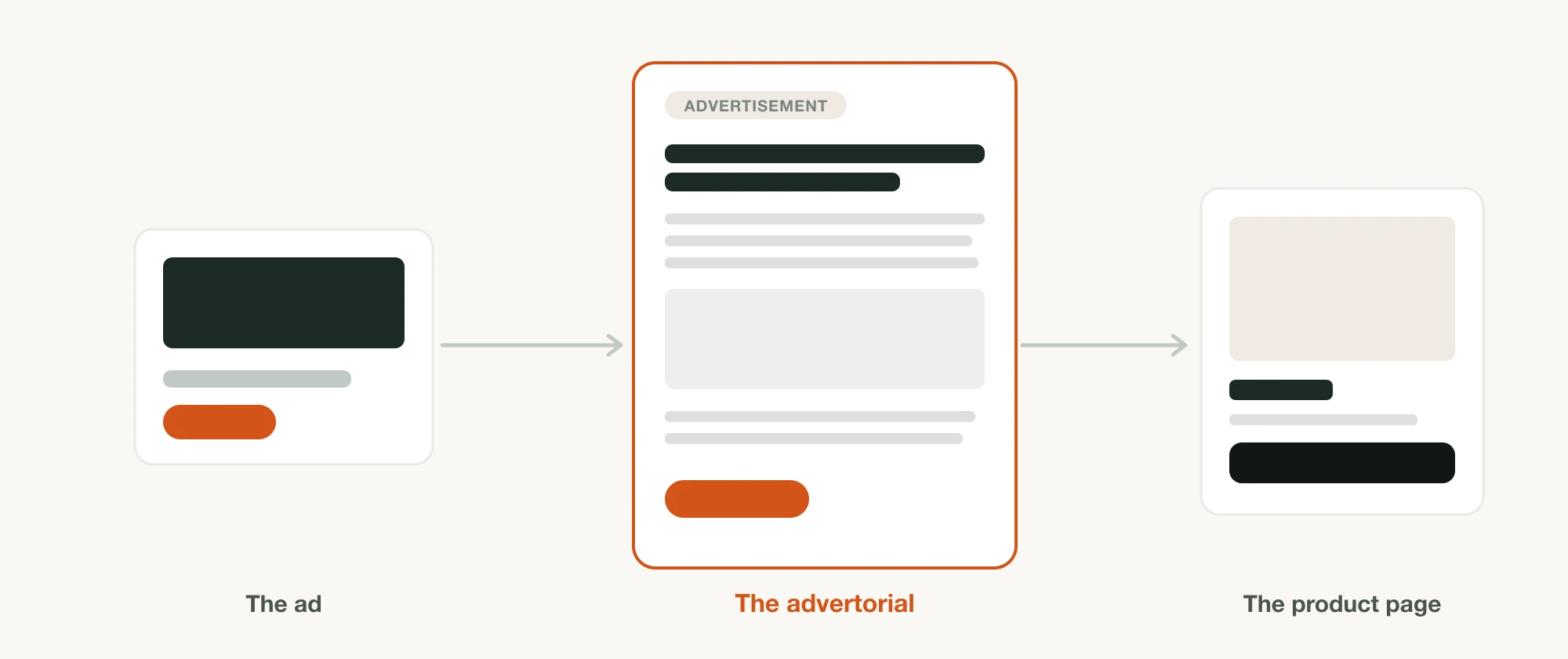
One distinction matters before the teardowns: an advertorial is a narrative, not a listicle. Plenty of DTC "advertorials" wear a "5 Reasons Why" headline; those are listicle-advertorial hybrids, and they belong in the listicle playbook. The examples here are the real narrative form: flowing prose that opens on a problem and tells a story toward the product. (Tellingly, the same brand often runs both: Goli, below, also runs listicle-style "reasons why" pages alongside this narrative one. You match the format to the traffic, not the brand.)
There's a simple discipline underneath every one: spend most of the page earning the right to pitch. Practitioners call it the 70/30 rule: roughly 70–80% of the page is education and story, and only the last stretch is the offer. That ratio is what makes an advertorial feel like content rather than an ad, and it's why the editorial frame lowers a cold reader's resistance: they're reading to learn, not bracing to be sold. Break the ratio (pitch on line one) and the page reads as exactly the ad the reader was trying to avoid.
The reported payoff is real but should be read as directional. TrueProfit estimates that sending Facebook traffic straight to a product page might convert "around 0.5%," while adding an advertorial in between "can jump to 3–5%" (a vendor figure). MHI Growth Engine's February 2026 benchmark similarly puts editorial landing pages at roughly 2–5% for cold traffic versus 1.5–3.5% straight-to-product (practitioner data). And CRO agency SplitBase reports that around 15% of advertorial readers click through to the offer. None are controlled trials — but they point the same way, and the examples below show why.
10 narrative DTC advertorials, torn down
Ten live pages, ten verticals, ten distinct openings on the same narrative spine. Each carries one repeatable move, and read in order, they run from the cleanest, fully-disclosed pages to the aggressive end where a disclosure label sits next to proof you can't verify.
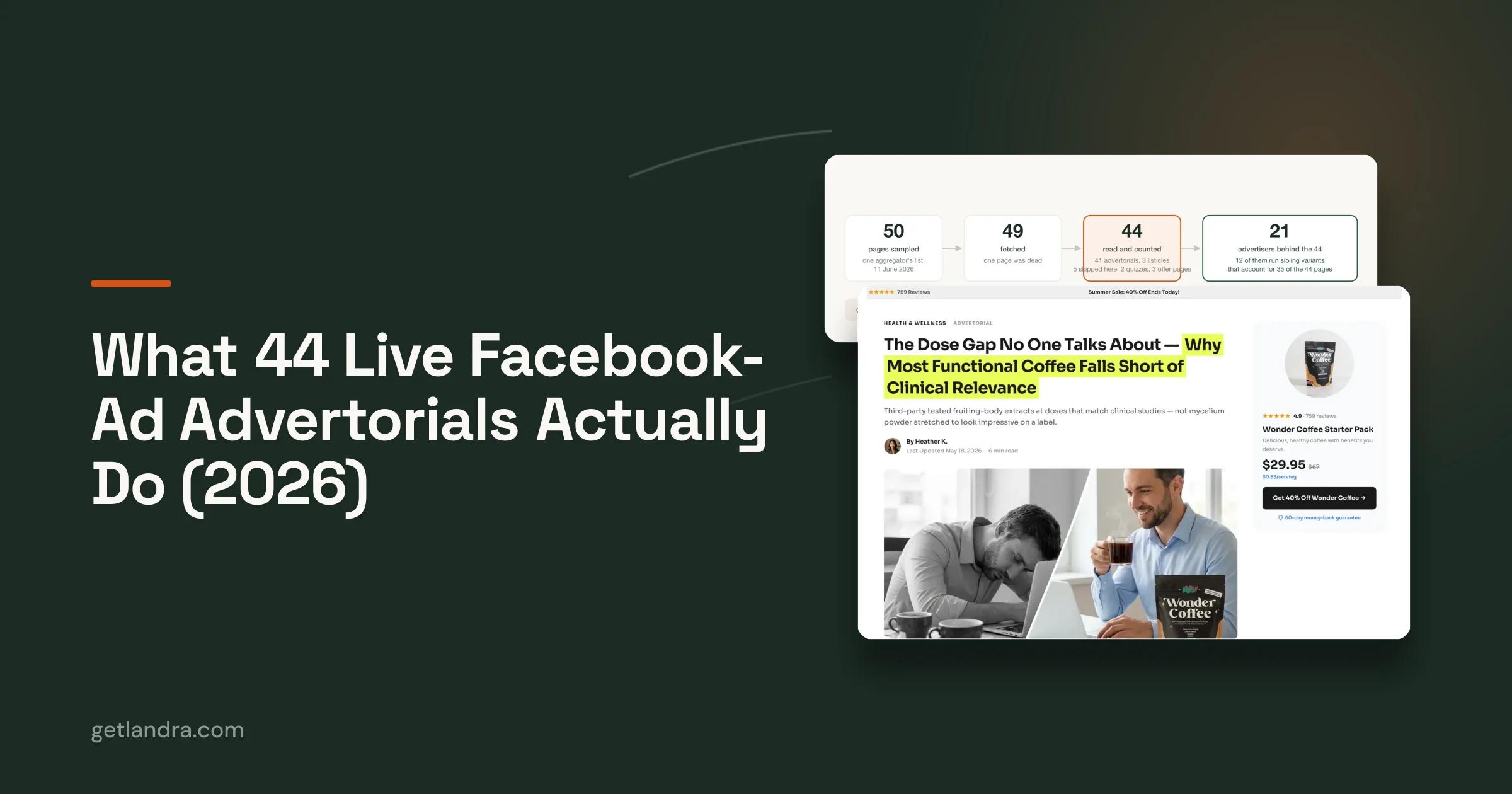
Prefer to browse by industry, with the full-length screenshots? The advertorial examples swipe file is the same teardowns as a gallery — one crawlable page per brand. And if you want the census rather than the close-reading, we later archived 50 live Facebook-ad advertorials and counted what 44 of them do: narrators, reveal timing, offer words, countdowns and disclosure, page by page.
1. Pow: open on the category's blind spot
Pow's "The Dose Gap No One Talks About" doesn't open on the product. It opens on the category's blind spot. Every mushroom coffee makes the same promises, it argues, so the difference can't be the promise; it's "what actually ships in the bag" — clinical-dose, third-party-tested fruiting-body extracts versus cheap mycelium powder grown on grain. It's a six-minute editorial, bylined and labeled "ADVERTORIAL," that teaches the mechanism before it ever names the Wonder Coffee offer.
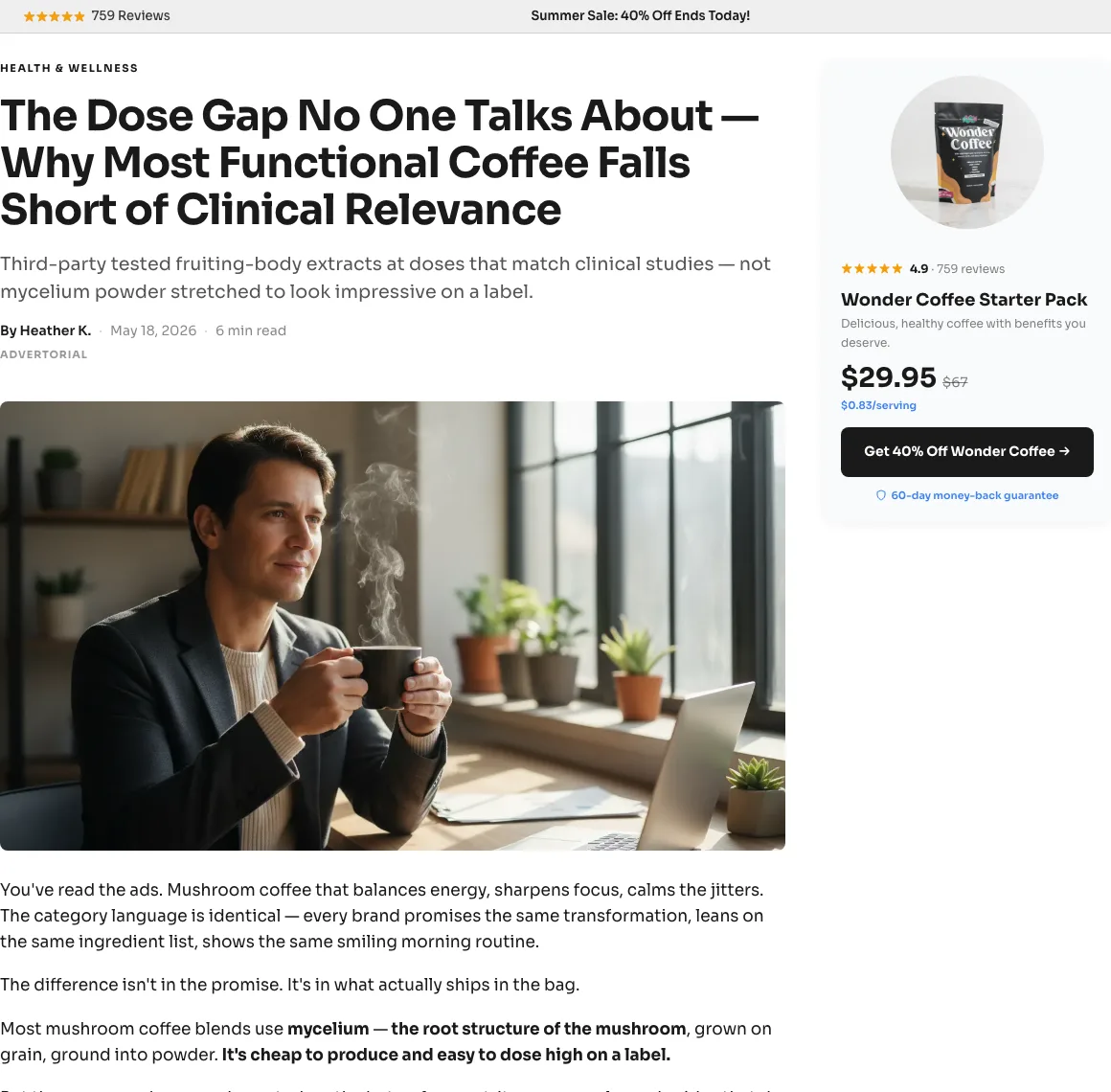
The move: open on the blind spot, not your product. A "here's what everyone in this category gets wrong" myth-bust earns the read because it promises the reader something they don't already know, and it reframes your product as the obvious fix once the gap is clear.
2. 8 Sheep Organics: open on the confession
8 Sheep Organics' "Confession: 'I HATED Being Pregnant, And Could Not Wait For It To Be Over…'" opens on the one thing the audience feels but won't say aloud. Admitting you hated being pregnant is taboo, and by saying it first, the writer gives the reader permission to feel it too, which earns the read instantly. From there it's a clean before/after narrative: a brutal first pregnancy versus a second one made bearable by better sleep, backed by named verified reviews and one limited offer. The family-owned, handmade framing adds founder-adjacent credibility without a fake newsroom.
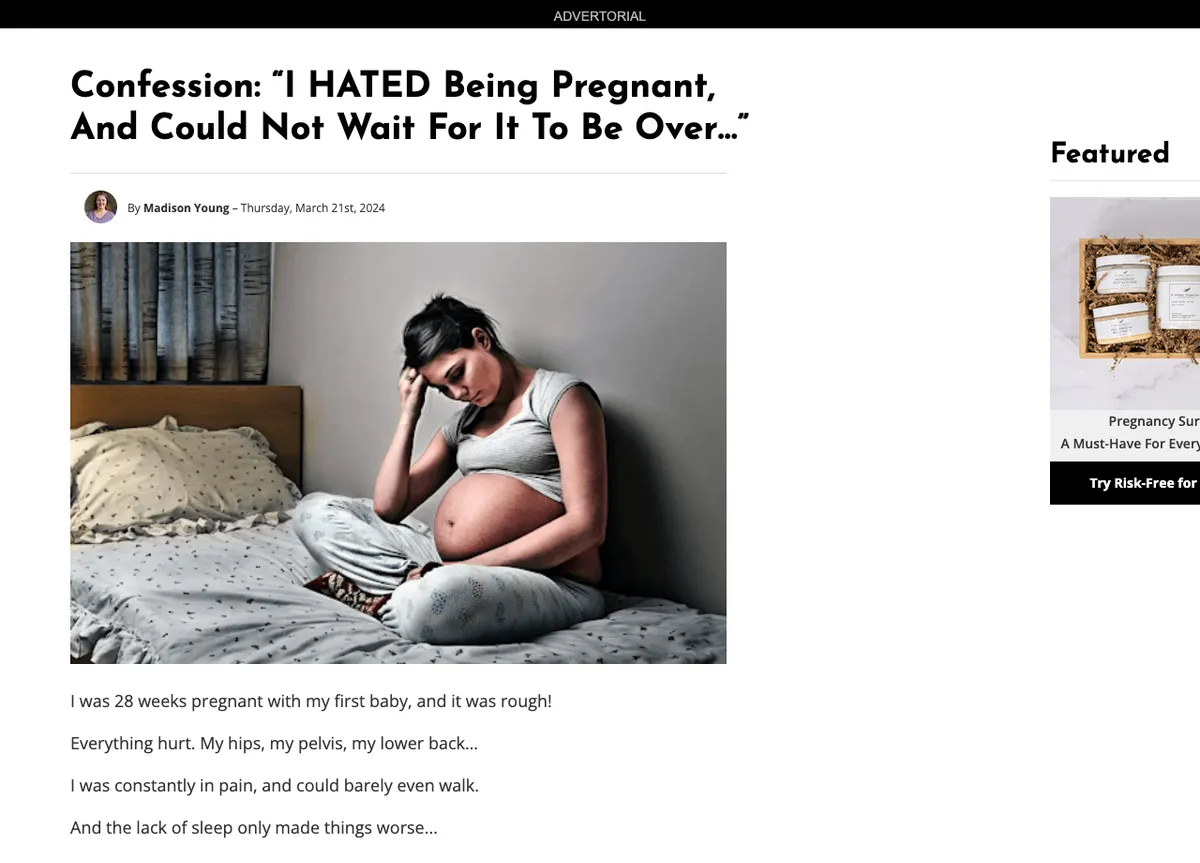
The move: open on the confession — the taboo admission your audience feels but won't say first. Saying it aloud builds instant rapport and gives the reader permission to lean in. Keep the claims in honest testimonial territory, the way 8 Sheep does, and the move stays clean.
3. Atlas Coffee Club: lead with the skeptic
Atlas Coffee Club's "I Thought Mushroom Coffee Was a Gimmick. I Was Dead Wrong." opens as the reader's own skeptic, and that's the whole trick. It voices the objection louder than the reader would themselves, then runs a first-person skeptic-to-believer arc through the ingredient mechanism, named reviews, and press badges to a 50%-off subscription offer. Because the page leads with doubt, the conversion is the reader watching a doubter get won over, which pre-empts the exact resistance cold traffic shows up with.
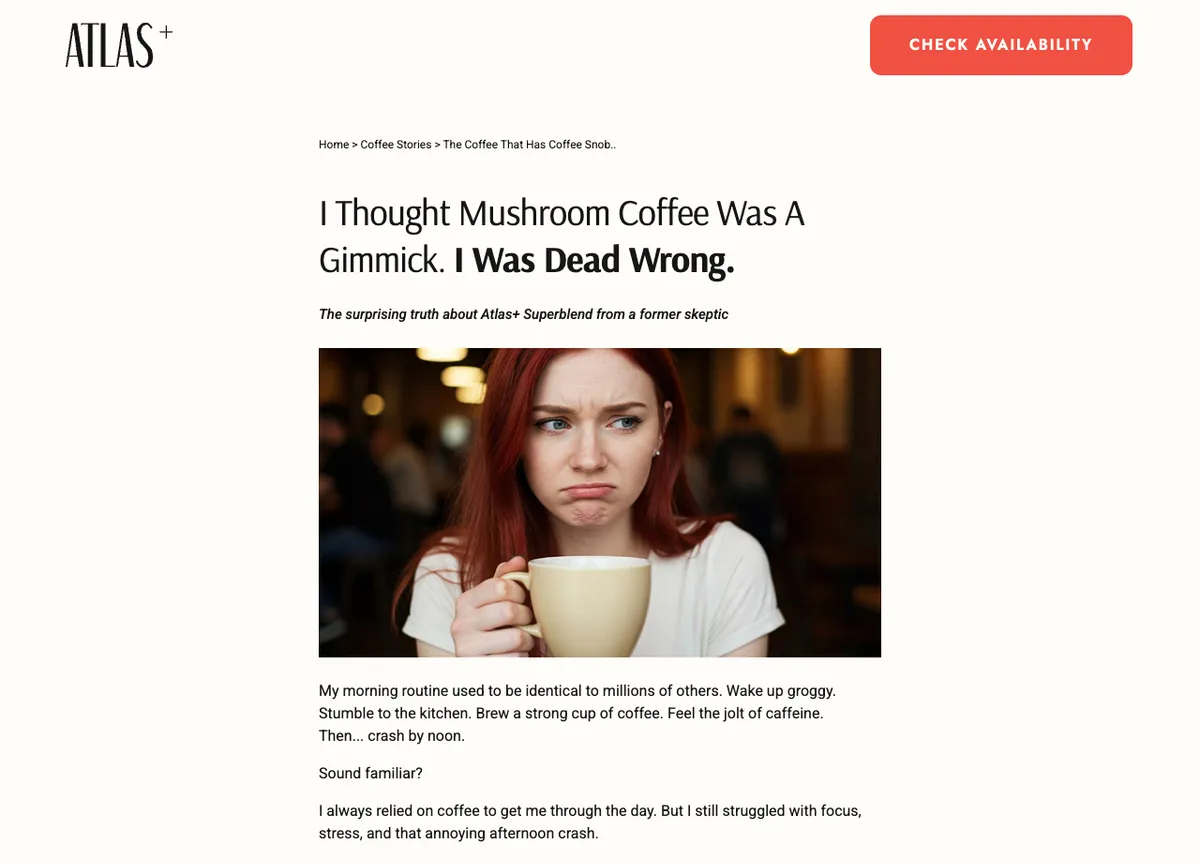
The move: voice the reader's skepticism for them, then earn the conversion by getting won over on the page. The caution: Atlas runs no "Advertisement/Advertorial" label in the body, buries its FDA disclaimer at the foot, and cites "Best Overall" press laurels that name no publication. Disclose the page, and never imply press you can't cite.
4. Goli: autopsy the category's failures
Goli's "Why Other Gummies Failed (and How Zero-Sugar bundle Provides Support)" pre-sells by performing an autopsy on the entire category before it ever pitches its own product. It walks through why competitors fail — sugar feeding bad gut bacteria, dead probiotic strains, underdosed ashwagandha — so the Zero-Sugar bundle reads as the corrected version rather than just another option. It's comparison-as-narrative, not a feature grid, and it's unusually well substantiated: a real named reviewer (Dr. Sheela Agarwal, MD), a third-party clinician panel (FrontrowMD), and cited trials on the KSM-66 ashwagandha extract.
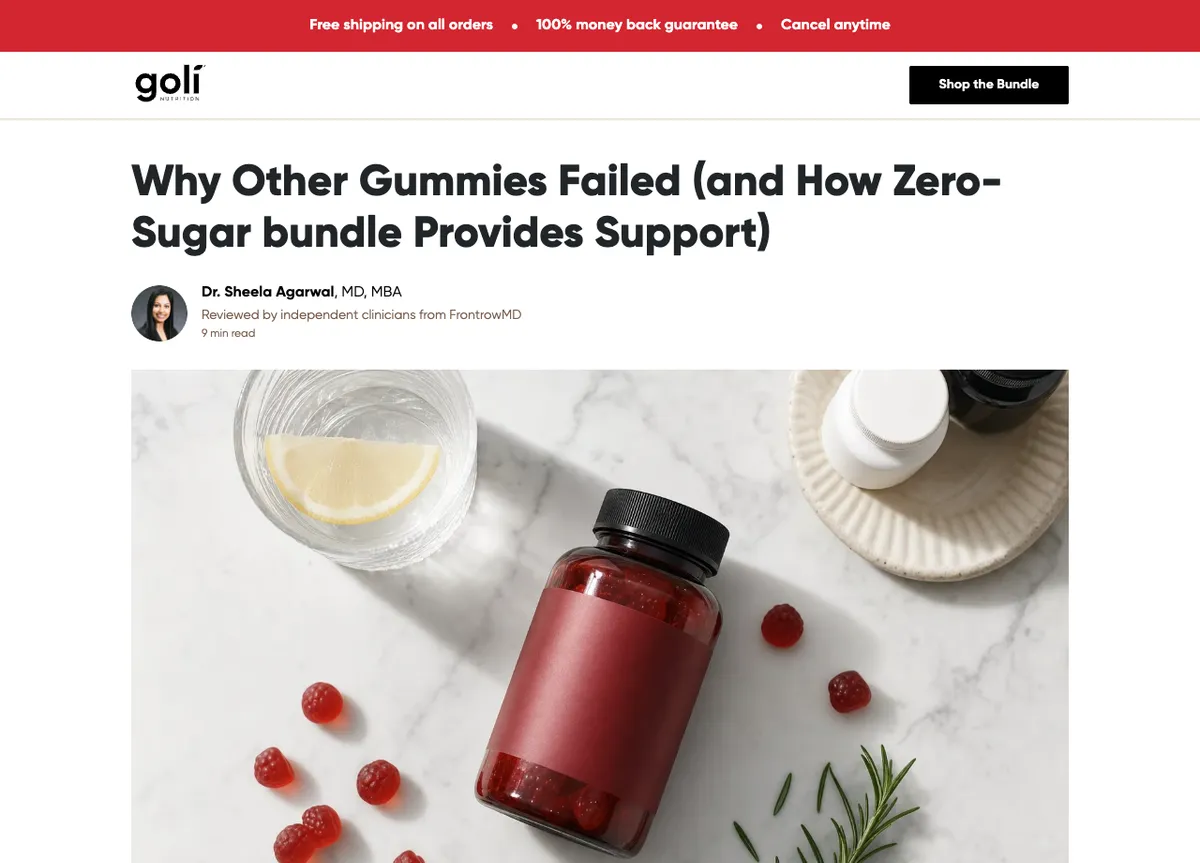
The move: pre-sell by autopsying the category's failures, not your product's features. When the reader understands why everything else falls short, your product becomes the obvious correction. Substantiate it the way Goli does, with real named clinicians and cited trials. The gap to fix: it carries no "Advertorial" label and leans on a "world's first" superlative — strong proof, missing the basics.
5. Uproot Clean: name the hidden problem
Uproot Clean's "A Hidden Ecosystem Inside Modern Washers Is Releasing Odor-Causing Molecules Into Every Load…" surfaces a problem the reader never thought to have: the machine that cleans your clothes is itself filthy. The headline names the hidden problem and the fix in one breath — a "NASA-inspired enzyme method" that dissolves the source instead of masking it. Then the page debunks the alternatives the reader has already tried, runs a personal testimonial and a comparison table, and closes on urgency, borrowing that "NASA" authority as a credibility shortcut throughout. The non-health vertical keeps the set varied.
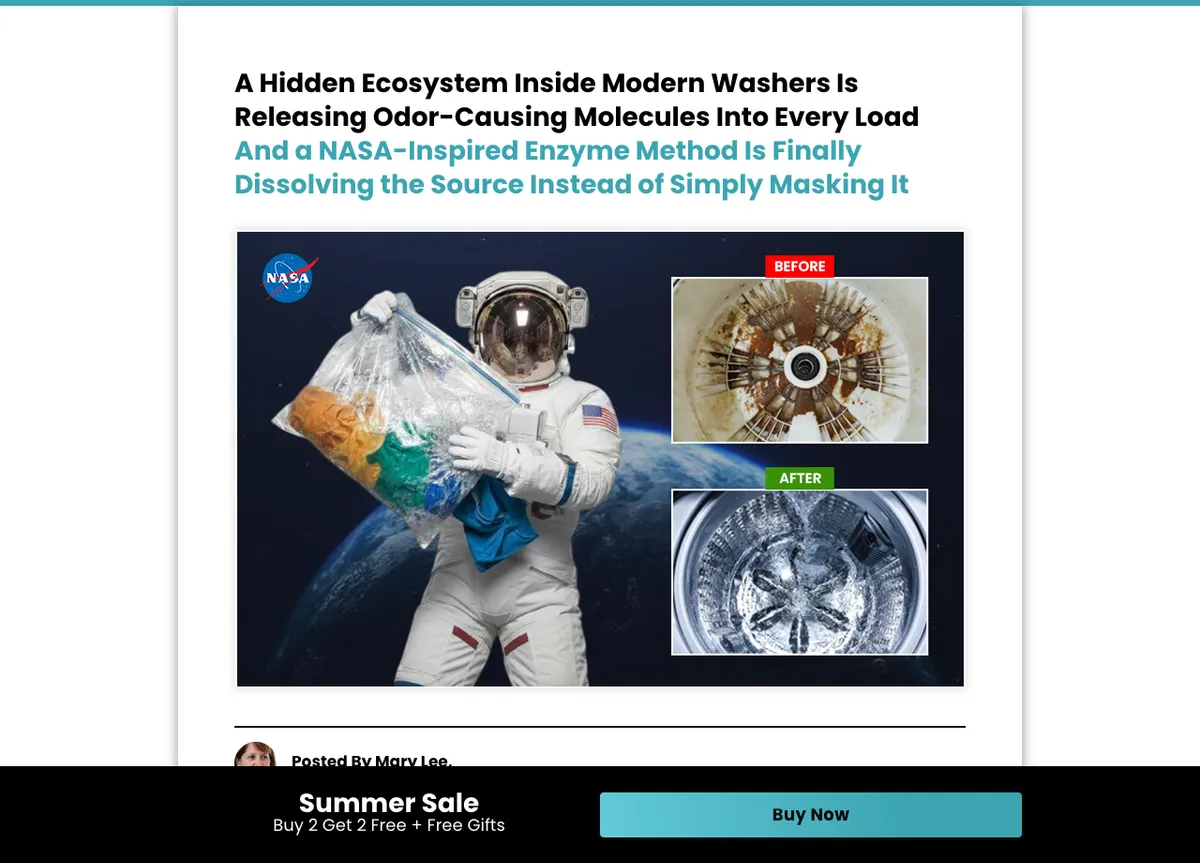
The move: name a hidden problem the reader never knew they had, then resolve it. Surfacing the unconsidered angle is what makes the page feel like a discovery. The caution: Uproot pairs that with borrowed institutional authority ("NASA") that's asserted but never cited, a generic uncredentialed byline, and no disclosure label. Borrowed authority without substantiation is a claim a regulator can challenge.
6. PetLab Co.: turn the pre-sell into a quiz
PetLab Co.'s dog-dental advertorial — "If Your Dog's Breath Makes Your Eyes Water, Try This for 30 Seconds Daily…" — turns the pre-sell into a diagnostic. It opens as an editorial problem article ("Cleaning Your Dog's Teeth: Why It Matters"; "80% of dogs aged 3 already have dental issues") and hands off to a "What Are The Signs?" quiz, so the reader diagnoses their own pet's problem before the product ever appears. The quiz personalizes the pre-sell and qualifies the lead; by the time the product shows up, the reader has talked themselves into needing it.
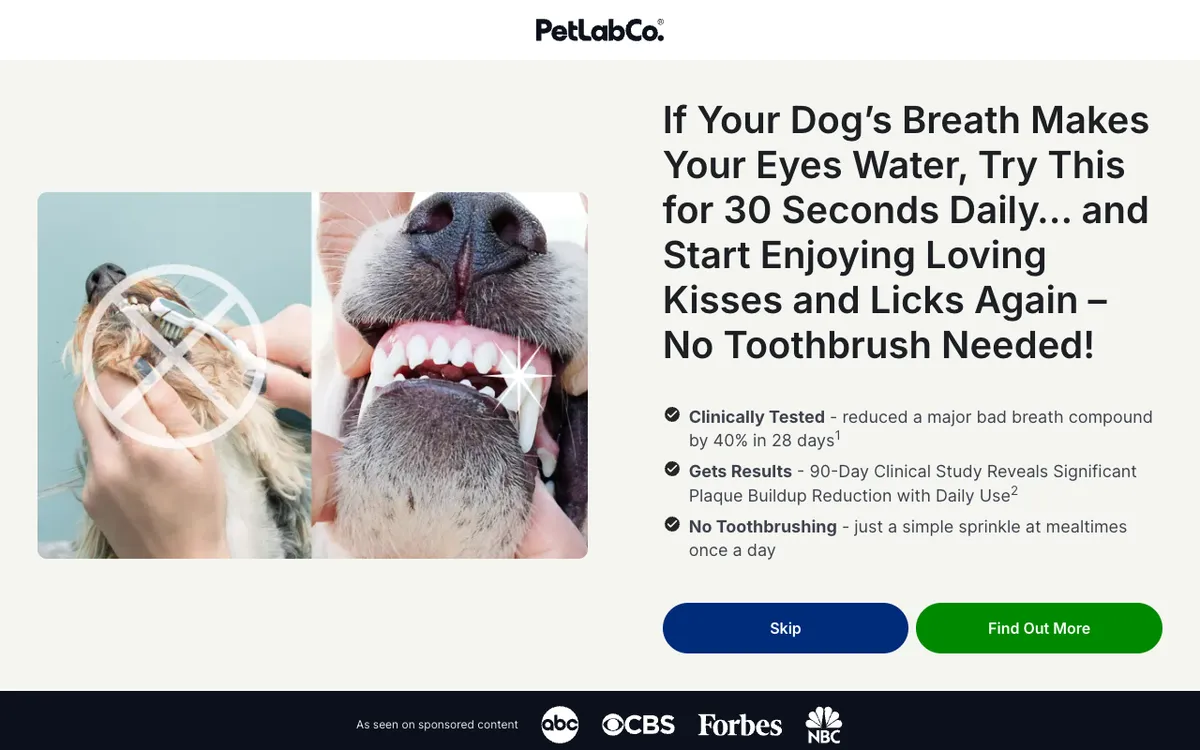
The move: route the pre-sell through a quiz. Let the reader diagnose their own problem before the product appears, and they arrive at the offer already qualified and committed. PetLab does the substantiation well (footnoted clinical claims like "40% reduction in 28 days"), but the only disclosure is small "as seen on… sponsored content" microcopy beside the press logos. A quiz funnel still needs a clear top-of-page label; "sponsored content" by the logos isn't the same as labeling the whole page.
7. LifeCell Skin: mirror the symptom, prove with before/after
LifeCell Skin's "Rough Skin, Dark Spots & Old Acne Scars?" opens by naming the reader's exact visible symptoms back to them: a question headline aimed at a low-awareness audience who haven't connected those symptoms to a single cause. It reframes them as the "earliest signs of aging," brings in a named dermatologist (Dr. James Porter, quoted), and then resolves the whole thing with real before/after photos of male faces. The before/after images are the proof engine here, a different mechanism from every other pick in this set.
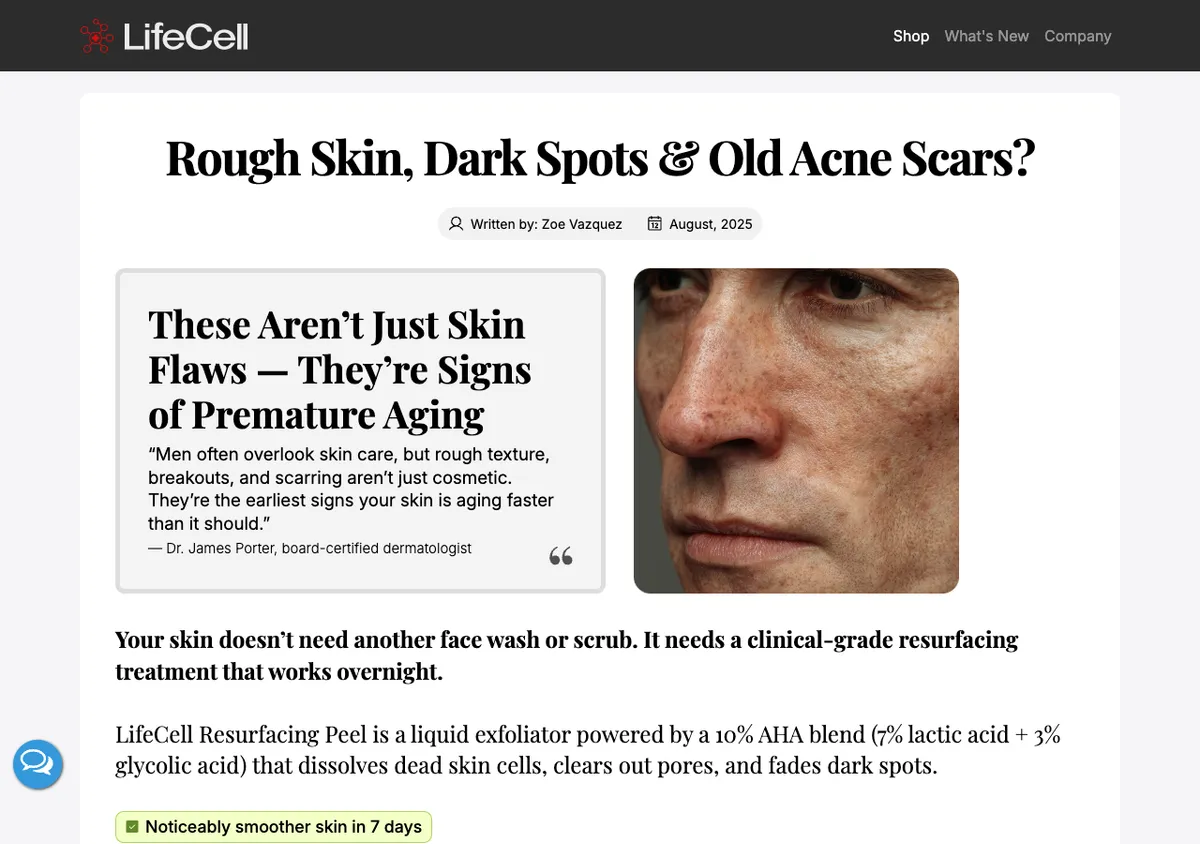
The move: name the reader's exact visible symptoms in the headline, then prove the fix with real before/after photos. Symptom-mirroring works on a low-awareness audience because it tells them you understand the thing they see in the mirror. The before/after is what to steal. The caution: LifeCell runs no FTC label, a generic byline, and aggressive claims ("acts like a facelift," "smoother skin in 7 days") that strain credibility.
8. SmoothSpine: put the expert's claim in the headline
SmoothSpine's "Top Physiotherapist: 'This Is the Fastest Way to Fix Sciatica for Good'" puts the expert's claim in the headline as a quote, so attributed authority does the persuading before the reader reads a word of body copy. From there it runs a personal narrative, an "the industry profits from your pain" framing, a stat stack (the brand claims 91% relief, 87% less medication, 21,500+ users), social proof, and a 72-hour urgency close. The headline move is genuinely effective, but this page comes with the single most important caution in the set.
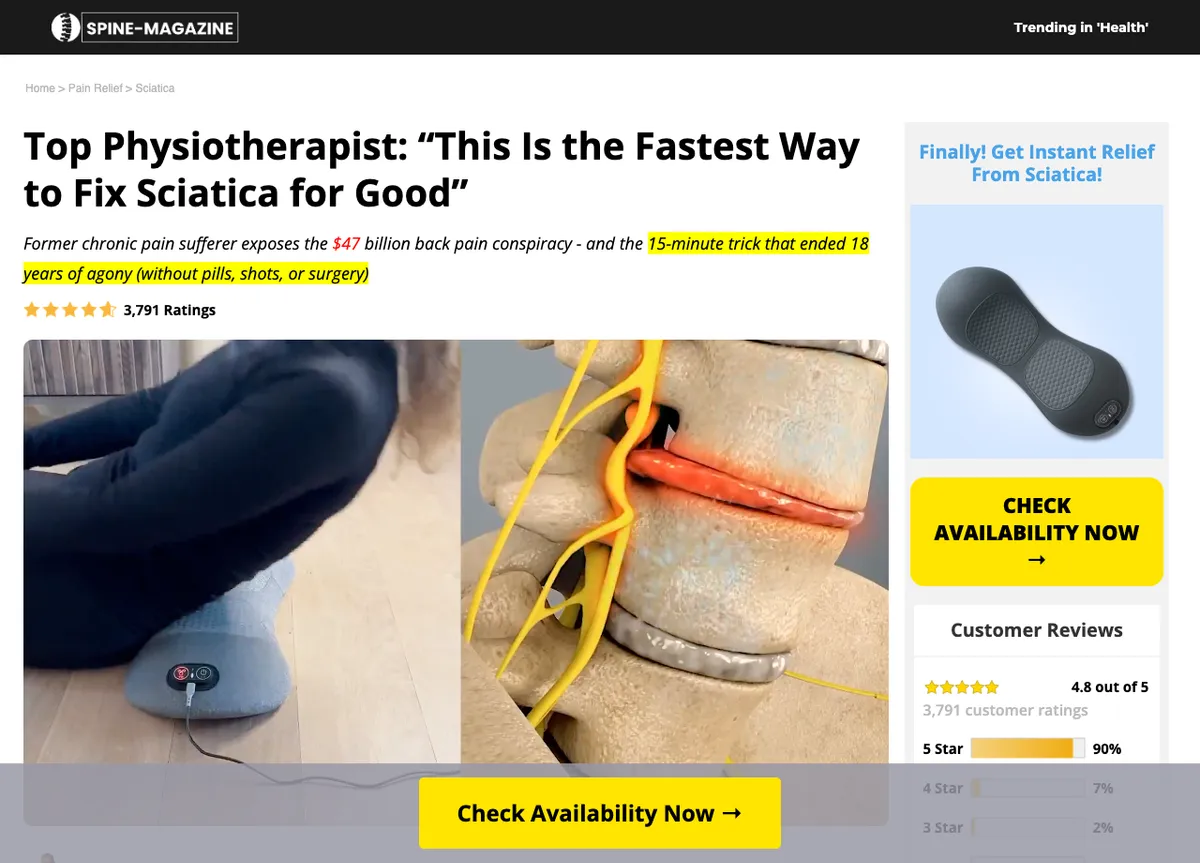
The move: put the expert's claim in the headline as a quote, so attributed authority persuades before the body copy starts. The caution is bigger than usual here, and it's worth seeing for yourself: SmoothSpine's "Dr. Blane Schilling" and its exact 91% / 87% stat block also appear on Treatmedy's bunion advertorial, a completely unrelated brand in a different vertical. The same expert and the same numbers, copied across two advertisers, are how you know a "named authority" template is circulating rather than reporting a real result. If you can't verify an expert independently, a reader can't either.
9. GroundingWell: teach the biology first
GroundingWell's lymphedema advertorial, "Leading Physical Therapy Specialist: The Best Method To Quickly Alleviate Lymphedema In Your Legs And Feet," is the clearest embodiment of the 70/30 educate-first ratio this whole guide preaches. Before the product appears, it teaches the underlying biology of the lymphatic system at real length, earning trust by genuinely informing rather than rushing the pitch. A specialist authority frames it; the product reveal, scarcity, a high-volume rating, and named testimonials follow only after the education lands.
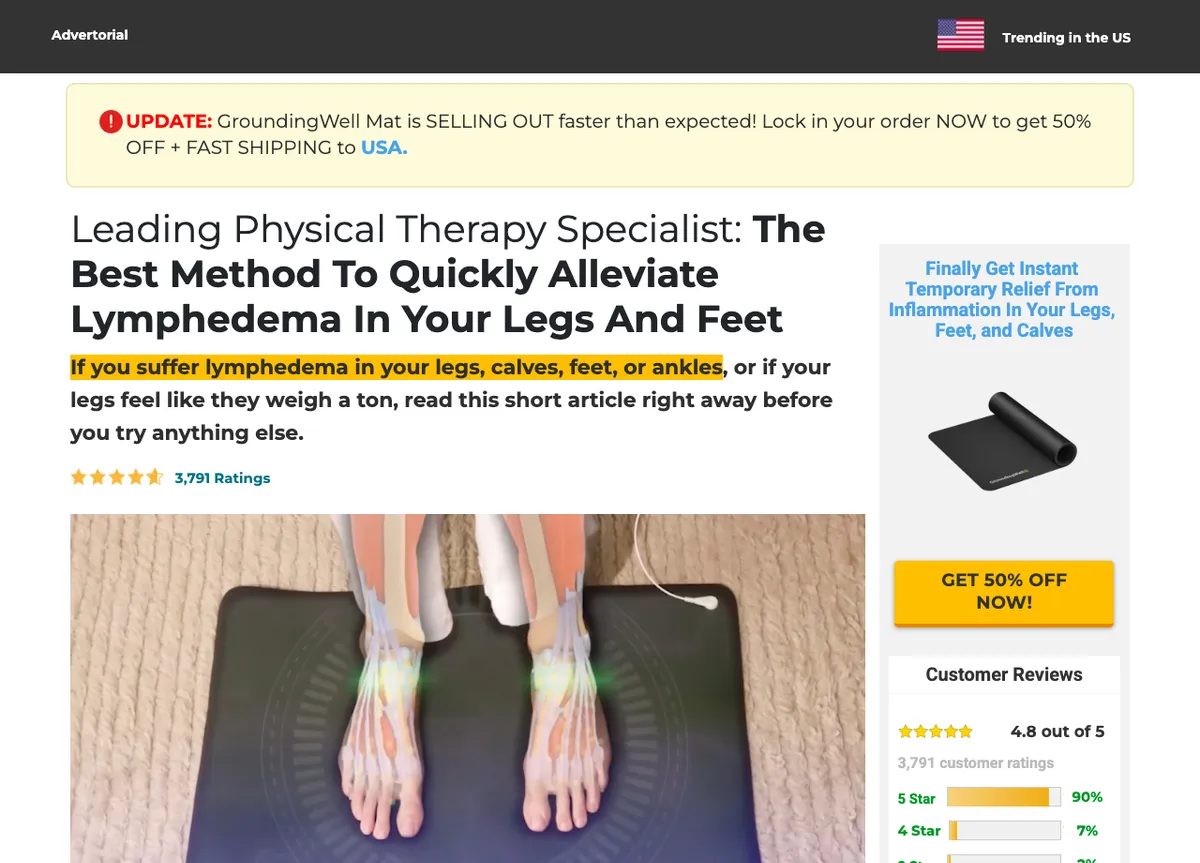
The move: teach the underlying biology at real length before the product appears. Deep education earns trust no benefit bullet can. GroundingWell does the structure right (it even carries a clean "ADVERTORIAL" label). The caution: the named "specialist" has no affiliation a reader can verify, and the page makes borderline disease claims ("alleviate lymphedema," "stimulate lymphatic drainage"). Educate deep, but mind the disease-claim line a supplement or device page can't cross.
10. Zephta: cast the industry as the villain
Zephta's "The Incredible True Story About Hair Loss Every Woman Should Hear" sits at the aggressive end of the spectrum. It casts the incumbent industry as a villain with motive ("Who profits from it? Big hair-care brands have everything planned"), turning the reader's frustration into distrust of competitors and trust in Zephta. It interlocks first-person narratives with a "Frozen Follicles" pseudo-mechanism, a named "expert," social-proof comments, and urgency. The conspiracy framing is potent, and it's also where the wheels can come off.
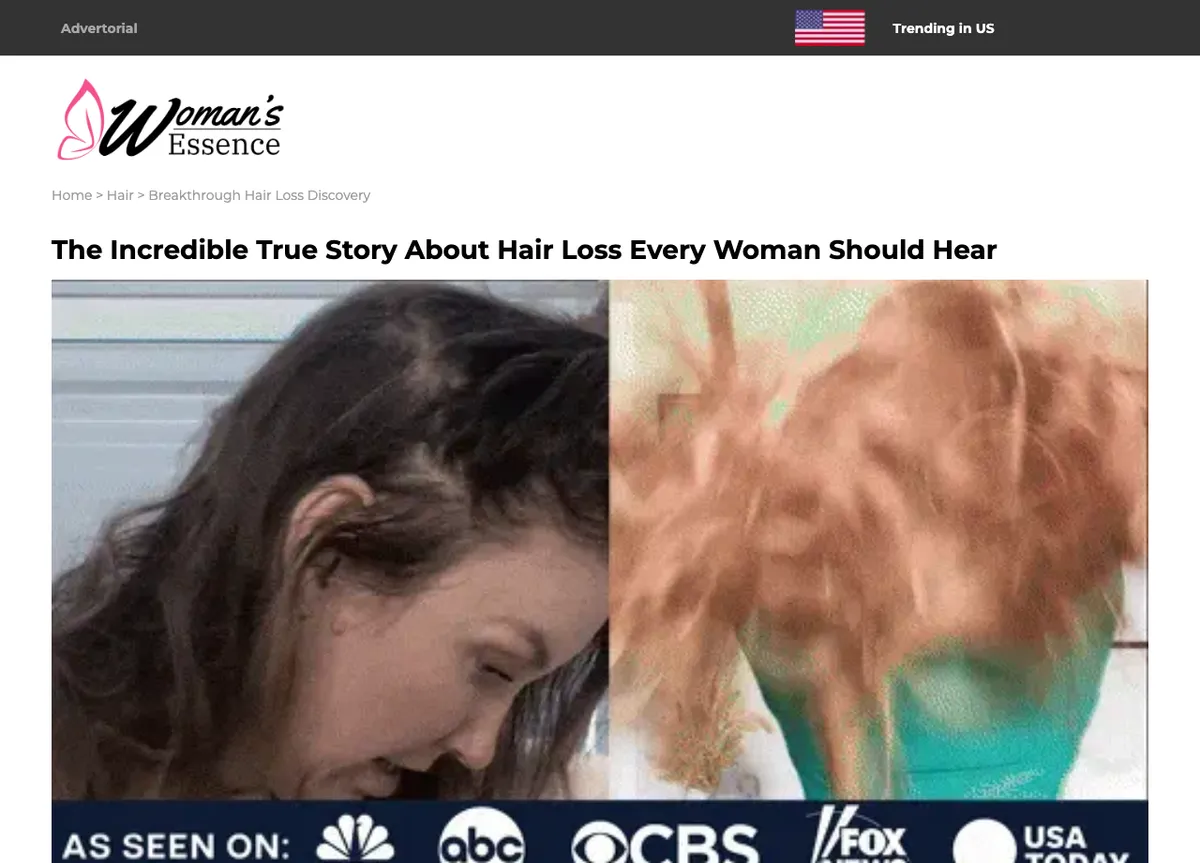
The move: cast the incumbent industry as a villain with motive. Conspiracy framing converts frustration into distrust of competitors and trust in you. Use it carefully. Zephta does carry an "ADVERTORIAL" label, but it's paired with an unverifiable expert, a precise-but-unsourced stat, Facebook-style comments that read as manufactured, and "poisoning your scalp" / "SCAM" language. The lesson, placed last on purpose: a disclosure label does not launder fabricated-looking proof or wild claims. Compare it to the clean anchors — Pow, 8 Sheep, Goli — and the difference is obvious.
The repeatable techniques
Across the ten, the same kind of move recurs: a different opening on the same narrative spine, each one engineered to lower a specific kind of resistance. To lift these as fill-in skeletons, see advertorial templates: 5 proven copy formulas. As a checklist:
- Open on the blind spot (Pow): the thing the category gets wrong, so your product is the fix.
- Open on the confession (8 Sheep): the taboo admission your audience feels but won't say first.
- Lead with the skeptic (Atlas): voice the objection louder than the reader would, then get won over.
- Autopsy the category's failures (Goli): teardown the competitors so your product reads as the correction.
- Name the hidden problem (Uproot): surface an angle the reader never considered, then resolve it.
- Turn the pre-sell into a quiz (PetLab): let the reader diagnose their own problem before the product appears.
- Mirror the symptom + before/after (LifeCell): name the visible symptom, prove the fix with photos.
- Put the expert's claim in the headline (SmoothSpine): attributed authority before a word of body copy.
- Teach the biology first (GroundingWell): deep education that earns trust before the pitch.
- Cast the industry as the villain (Zephta): conspiracy framing that converts frustration into distrust of competitors. The aggressive end, handle with care.
- The 70/30 rule (all): spend ~70–80% of the page educating before you pitch.
A teardown is most useful when you watch one done in full — we take a shower-filter advertorial apart claim by claim in our advertorial teardown, including how an unverifiable expert and an unsubstantiated health claim turn a strong page into a regulatory risk.
The one thing most advertorials get wrong: disclosure
Disclosure is where these pages split into the honest and the deceptive, and the gap is bigger than you'd think. The FTC's native advertising guidance is explicit: the more a paid page resembles editorial content, the clearer its "this is an ad" label must be, placed before the headline and visible on every device. Plain words like "Advertisement" or "Advertorial" satisfy it; vaguer phrasings ("presented by," "promoted") may not.
The split across the ten is instructive, and it sorts into three groups.
The clean anchors. Pow and 8 Sheep Organics both label themselves unmistakably ("ADVERTORIAL" at the top), carry a real dated byline, keep claims in honest territory, and still convert: proof there's no upside to hiding it. 8 Sheep even closes with an FDA disclaimer at the foot. These are the version you want to copy outright.
Good proof, missing label. Goli is unusually well substantiated (a real named MD, a third-party clinician panel, FDA disclaimers, cited trials) yet it still skips the "Advertorial" label and reaches for a "world's first" superlative. It's the most fixable case in the set: the proof is real, the label is a one-line omission.
The cautionary cases. Two shapes. The first is the missing label: Atlas, Uproot, and LifeCell run no clear top-of-page disclosure (Atlas also cites "Best Overall" press laurels that name no publication; Uproot asserts a "NASA" association it never cites). PetLab is a near-miss: its only disclosure is small "sponsored content" microcopy beside the press logos, which isn't the same as labeling the whole page. The second shape is more serious — labeled, but the proof doesn't hold up. GroundingWell and Zephta both carry an "ADVERTORIAL" label and pair it with unverifiable "experts," borderline disease claims (GroundingWell), or precise-but-unsourced stats and manufactured-looking comments (Zephta). A disclosure label does not launder fabricated-looking proof.
The clearest red flag in the whole set is reuse. SmoothSpine's "Dr. Blane Schilling" and its exact 91% / 87% stat block also appear, word for word, on Treatmedy's bunion advertorial: an unrelated brand in a different vertical. The same named "expert" and the same numbers, copied across two advertisers, are how you can tell a fabricated-looking authority template is circulating between advertisers rather than reporting a real clinical result. When you see an expert you can't verify independently, assume the reader can't either.
The rule underneath all of it: a real disclosure at the foot helps, but a missing label, a fictional masthead, an unverifiable expert, or a wild health claim are exactly the deceptions regulators chase. Borrow the editorial structure, disclose loudly, and keep your claims true.
Match the format to the reader
Narrative advertorials win where the reader is genuinely unaware or the purchase needs real explaining; they educate deepest and hold up over more of the funnel. For a reader who already feels the problem — comparison-ready traffic, but cold problem-led traffic too — a scannable listicle landing page often converts better, and the full trade-off is in advertorial vs listicle. Pick the format from the reader's awareness, not the traffic temperature alone.
Build your advertorial with Landra
Every example above is built on the same structure — problem, mechanism, proof, objections, one offer — executed for a specific reader. That structure is exactly what Landra generates. In fact, the Pow advertorial at the top of this guide was built with Landra: you tell it your product and the audience you're targeting, and it writes the whole optimized advertorial — the hook, the narrative arc, the proof, the copy, and the images — tuned to that reader and ready to edit in minutes.
You don't start from a blank page or reverse-engineer someone else's; you start from a complete, best-practice advertorial and make it yours.
The bottom line
The narrative advertorials that convert all do the same things: they earn attention before they sell, open on a problem or a story, follow problem → mechanism → proof → offer, and disclose themselves honestly. Study the ten live ones, copy the moves, match the format to cold traffic, and label the page — without faking a newsroom or an expert. Then build your own with the 5-step framework — or let Landra generate one tuned to your audience.
Frequently asked questions
What is an example of an advertorial?
8 Sheep Organics' "Confession: I HATED Being Pregnant…" is a clean DTC example: it carries an "ADVERTORIAL" label, opens on a relatable confession, tells a before/after story, adds named verified reviews and a foot-of-page FDA disclaimer, and closes with one offer. It reads like an article but is disclosed as paid content.
Do advertorials convert better than product pages?
For cold paid traffic, the reported answer is yes. TrueProfit estimates that sending Facebook traffic straight to a product page may convert around 0.5%, while adding an advertorial in between can reach 3–5% — a vendor figure, so directional. The mechanism is sound: cold readers need education before a product page can close them.
How long should an advertorial be?
Long enough to move a reader from a problem to a decision — typically 800–2,000 words. Practitioners often cite a 70/30 split: spend roughly 70–80% of the page educating before you pitch. Let the price and complexity of the product decide; a $25 product needs less than a $300 one.
Are advertorials legal, and do they need a disclosure?
Yes, they're legal and widely used — but the FTC requires that paid content designed to look editorial be clearly labeled as advertising, with the disclosure placed before the headline. Words like "Advertisement" work; vaguer ones like "presented by" may not. And never fabricate a publication or an expert byline.