
If you are a DTC or ecommerce marketer choosing a landing page tool, Replo and Landra solve the same problem in very different ways. This comparison lays out how each works, who each is for, and how to decide, without the marketing gloss.
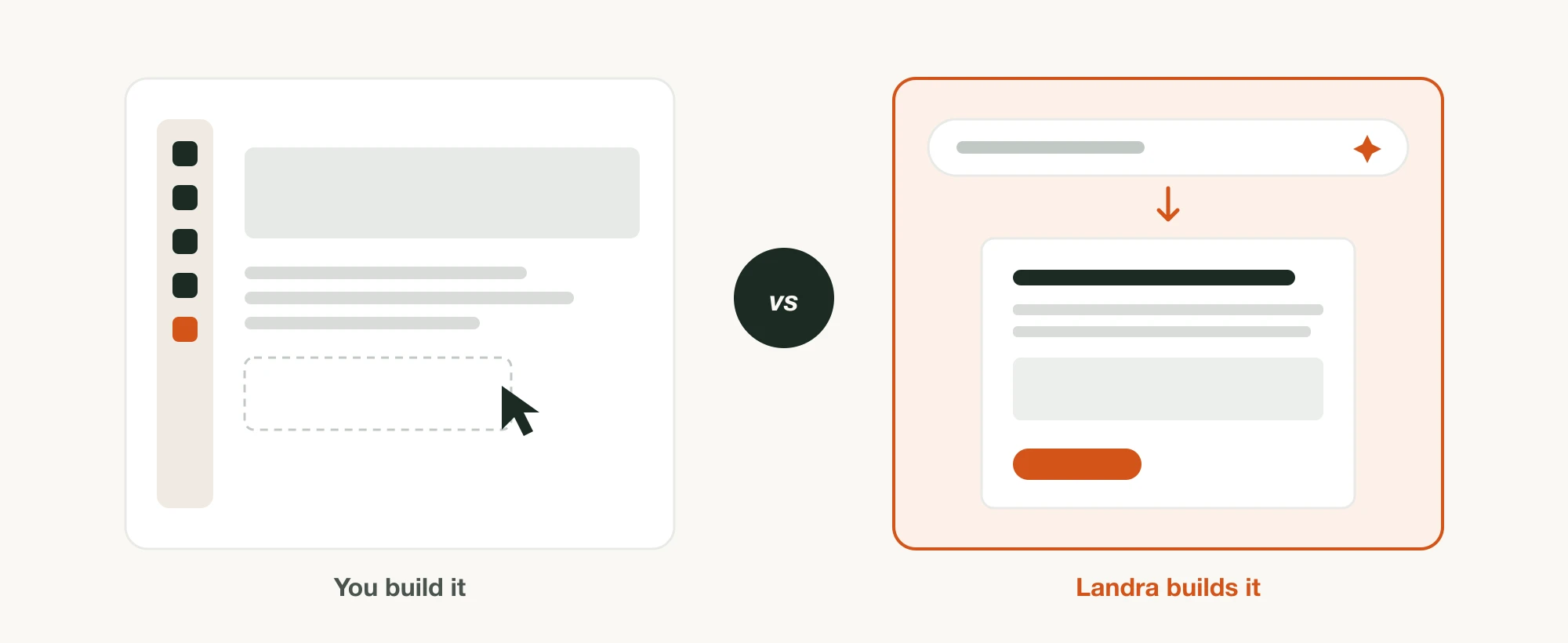
The headline difference is not how much of the page you build by hand. It is what you get back. With a visual builder you get a blank canvas and the control to build a page that is as good as you make it. With Landra you get a fully-optimized advertorial or listicle — copy, structure, pixels, and images, tuned to the audience you're targeting — built for you, then yours to edit.
Replo vs Landra at a glance
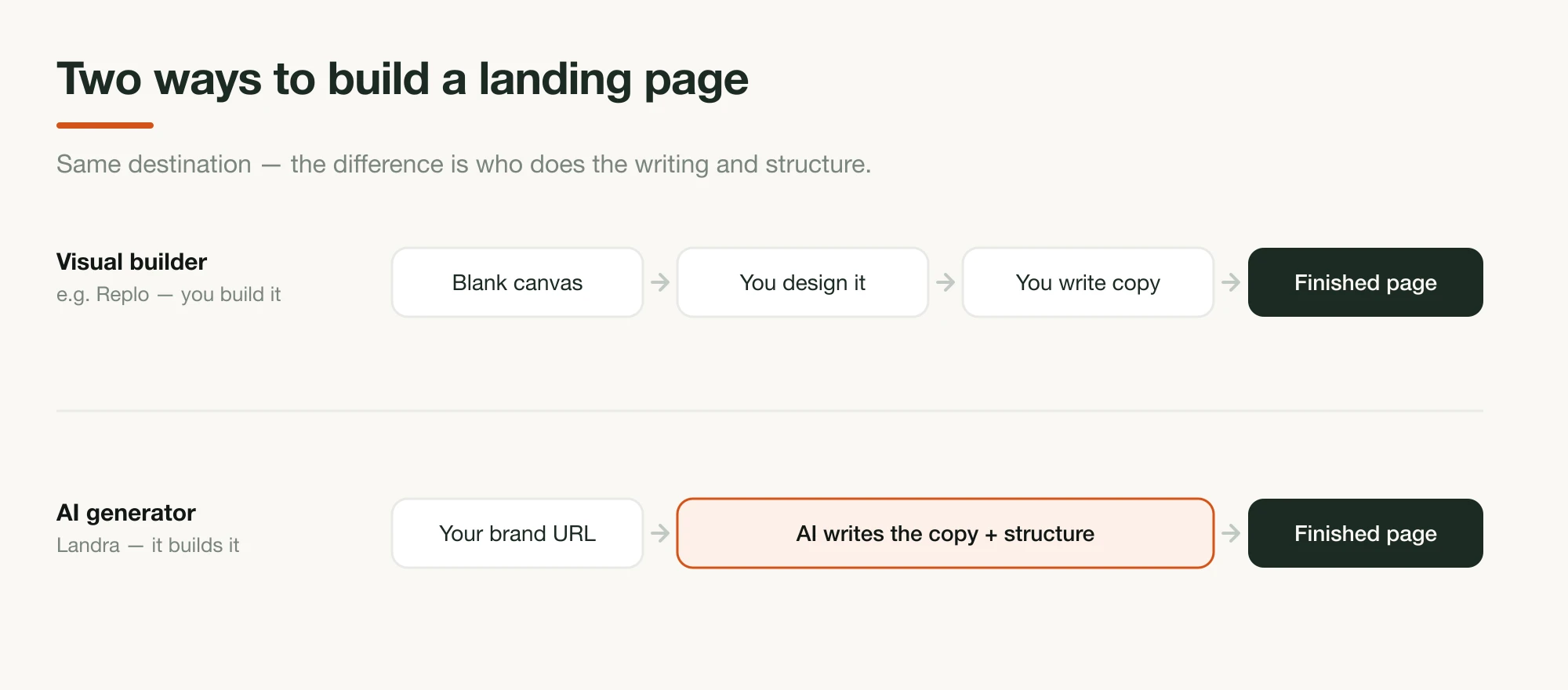
The core difference is DIY control versus a fully-optimized page done for you. Replo is a Shopify-native visual builder: you assemble pages by hand from a component and template library, with deep access to your store's theme and product data. Landra does it for you: you give it a brand URL and the audience you're targeting, and it builds a complete, fully-optimized long-form page — copy, structure, and images — that you then edit.
| Feature | ReploBest for hands-on, Shopify-native design | LandraBest for the optimized page built for you |
|---|---|---|
| Core approach | Visual drag-and-drop builder | Builds the full optimized page from a brand URL |
| You supply | Layout, copy, and assets — every page | A brand URL + your target audience, then edits |
| Best for | Bespoke, pixel-level page design | Fully-optimized advertorials & listicles, built for you |
| Page types | Any layout you build | Advertorials, listicles, editorial pages |
| Shopify integration | Native, deep theme & product integration | Publishes to a hosted URL or connected Shopify |
| The work | You design, write & optimize it | Done for you, then you refine |
| Pricing to publish | $99/mo Starter · $499/mo Pro | From $19/mo · 14-day free trial |
| Learning curve | Builder skills required | Paste a URL, then edit |
How Replo works
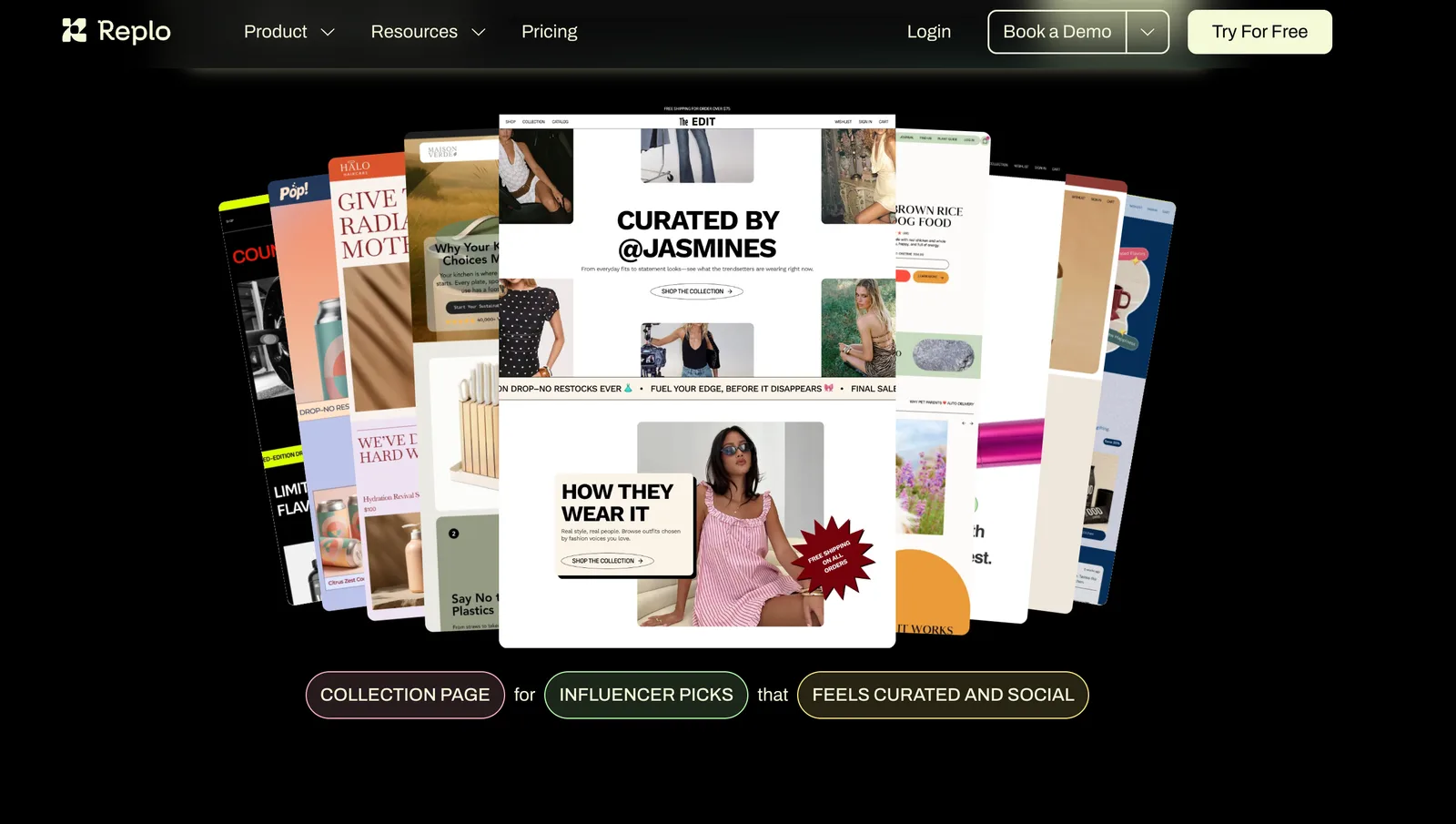
Replo gives you a visual canvas and a library of pre-built components and templates designed for Shopify stores. You drag in sections, bind them to live product data, style them to match your theme, and publish, all with fine-grained manual control over layout and design. A "Build with AI" mode can generate a starting page from a prompt, an image, or a URL, and its Image-to-Page feature replicates a visual reference, but the canvas is still yours to assemble and edit. Replo describes itself as built for selling "with your channel of choice, not just Shopify" (it now offers its own checkout and hosted sites), though its deepest strength remains native Shopify theme and product integration. It's a powerful fit for teams that have a clear design in mind and want to execute it precisely. Replo's own case studies feature DTC brands like Jibby Coffee, POSSIBLE, and Nathan James, often built alongside a growth agency such as VaynerCommerce.
The trade-off is that the page is only as good and as fast as the person building it. You bring the copy, the structure, and the design decisions. For a polished custom storefront section, that control is the point; for a long-form advertorial under deadline, it is a lot of manual work, which is why much of Replo's marquee work runs through agencies in its Replo Experts network. Replo gives you a better paintbrush; it does not paint the picture for you.
How Landra works
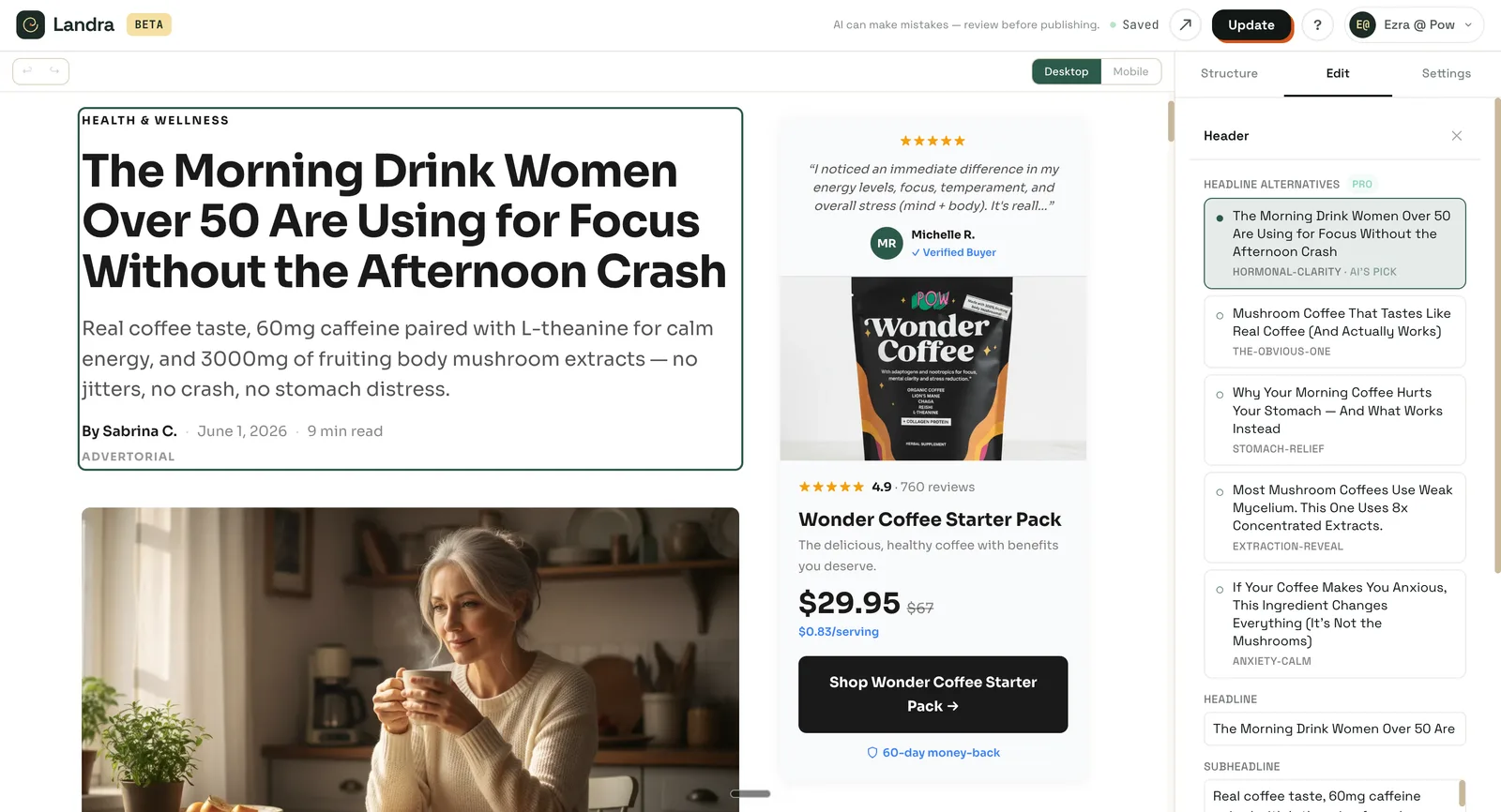
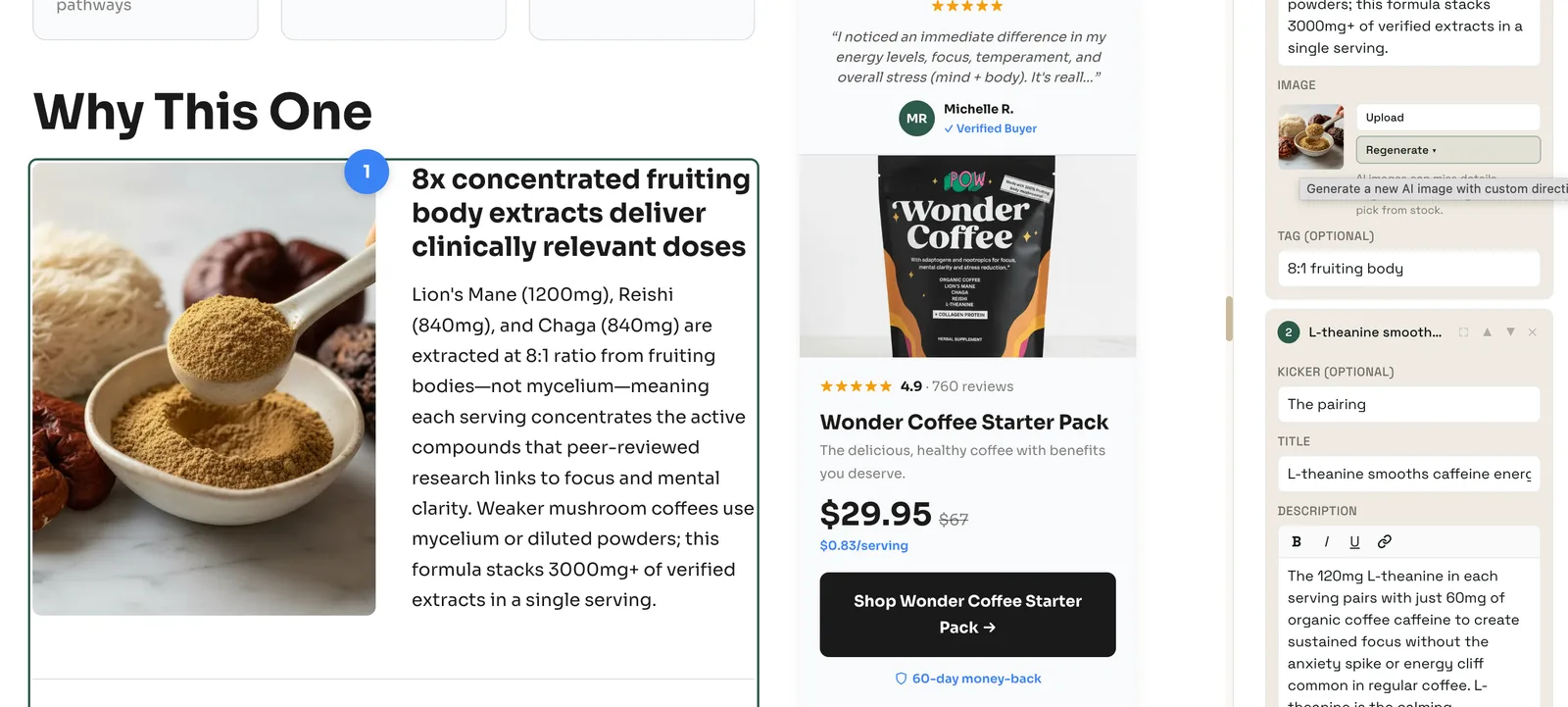
Landra starts from your brand URL. It analyzes your site, then generates a complete page in the format you choose — an advertorial, a listicle, or an editorial blog page — including the narrative copy, the section structure, and AI-generated images. You land in a WYSIWYG editor with a finished draft and refine from there.
In other words, Landra owns the part Replo leaves to you: the writing and the structure. If you want to learn the format Landra specializes in, see how to write an advertorial and what an advertorial is.
How to choose: build it yourself, or have the page built for you
The choice comes down to one question: do you want to assemble the page yourself, or have an optimized, best-practice page built for you? With Replo you get control and a blank canvas: the page is as optimized as your own expertise makes it, and you own every decision — the structure, the words, the layout, the images, the conversion logic. With Landra you get the whole thing done for you: a fully-optimized advertorial or listicle with the format's best practices already built in (structure, copy, pixels, and images, tuned to the audience you name).
So the cleanest way to choose is to ask what you actually want. If you have the expertise and the time and you want hands-on control over every pixel, Replo's manual canvas is an asset. If you want the best-practice advertorial or listicle, fully optimized to educate and convert your specific customer without pushing pixels or agonizing over structure, that is exactly what Landra hands you. You could build a perfectly fine page yourself; the question is whether you'd rather have the optimized one built for you in minutes.
Speed to a finished page
Speed is where the two approaches diverge most. With a visual builder, time-to-publish scales with the complexity of the page and the skill of the builder. A long-form advertorial with custom sections is a meaningful chunk of a day, sometimes more. With Landra, the first complete draft arrives in minutes because the copy, structure, and images are generated together, not assembled by hand.
That difference compounds when you test. If a new angle costs an hour instead of a day, you run more experiments, and more experiments is how landing-page performance actually improves. The builder route rewards getting one page exactly right; the generator route rewards getting many pages live and letting the market choose.
Shopify and publishing
Replo is built around Shopify. Its theme integration, product binding, and in-admin workflow are tightest if your entire operation lives inside the Shopify ecosystem. That is a genuine strength, and for a Shopify-only team it is a real reason to favor it. Replo has since added its own checkout and hosted sites to sell beyond Shopify, but the native theme-and-product integration is still where it's strongest.
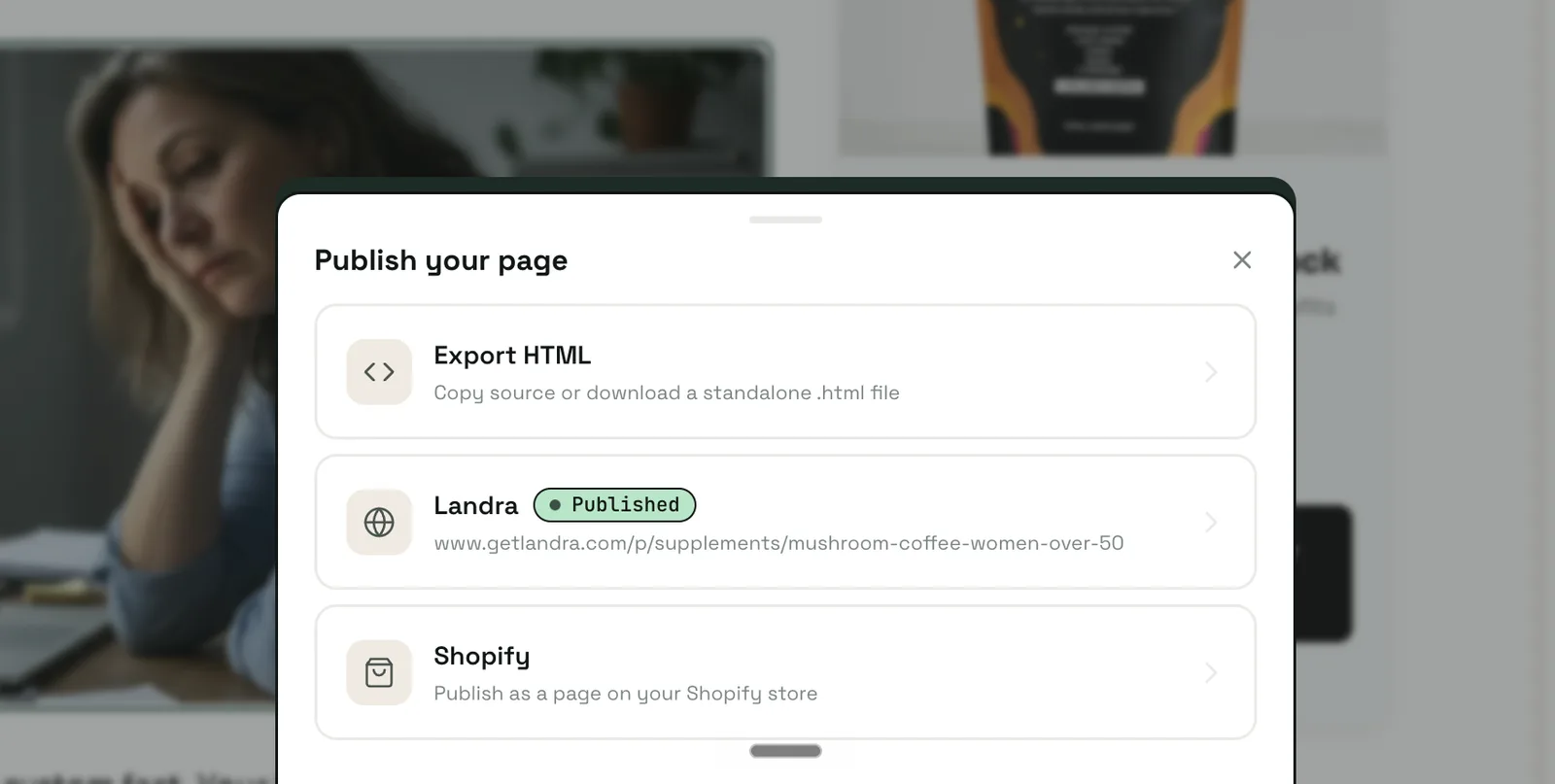
Landra is standalone. It publishes to a fast hosted URL or to a connected Shopify store, which suits brands running paid traffic to dedicated landing pages and teams that aren't exclusively on Shopify. If you need pages tied deeply into your live storefront theme, weigh that; if you mainly need conversion-shaped pages to send ads to, the hosted route is often simpler.
Pricing: what you are paying for
Pricing models matter as much as headline numbers, and the two tools charge for different things. As of June 2026, Replo's pricing starts with a free plan for design and preview; publishing to your store begins on the Starter plan at $99/mo (which includes 15 published items), and the Pro plan is $499/mo. You're paying for the canvas, the component library, and the Shopify integration you use continuously. Landra runs a 14-day free trial, then from $19/mo, and is priced around generation: the value is the finished draft and the speed of testing new angles. Frame the decision around what each charges you to do, not just the monthly line item.
The honest way to compare cost is per-tested-page, not per-month. A cheaper tool that takes a day per page can be the more expensive choice once you account for the hours, especially on a small team. And the page itself, not just the ad, is what decides whether spend converts: one DTC benchmark from MHI Growth Engine (February 2026) puts a typical product page at a 1.5–3.5% conversion rate and a dedicated landing page at 2.5–5%. So a better page, built faster, compounds directly into return on ad spend.
Is AI-generated copy good enough to convert?
This is the fair objection to an AI-first tool, and it deserves a straight answer: a generated draft is a strong starting point, not a finished campaign. The advantage is not that the machine writes a flawless advertorial on the first pass — it is that it eliminates the blank page and gets the structure right, so your editing time goes into the few sentences that actually move conversion instead of into staring at a cursor.
The quality also depends on what the tool understands about the format. A generic AI writer produces generic copy. Landra is built specifically around the advertorial, listicle, and editorial structure described in how to write an advertorial — it leads with the problem, builds to a mechanism, and keeps one call to action in view, because those patterns are baked into how it generates. You still bring the brand judgment and the final polish; the tool brings the first 80% in minutes.
A visual builder sidesteps the question entirely by making you the writer. That is the right trade if you have a copywriter who is faster than any draft tool. For most lean DTC teams, editing a structured draft is meaningfully faster than writing from scratch — which is the whole reason the category exists.
What each tool does best
Neither tool is strictly better — they are optimized for different jobs.
Replo is the stronger choice when you:
- Want hands-on, pixel-level control over every section
- Live entirely inside the Shopify admin and theme
- Are building bespoke storefront sections, not long-form editorial
- Already have the copy and structure and need precise execution
Landra is the stronger choice when you:
- Want a complete, fully-optimized advertorial or listicle built for you, fast
- Are testing many angles and need to ship pages quickly and cheaply
- Want the whole optimized page — copy, structure, and images — handled for you, not just the layout
- Are a lean team where building an optimized page at all is the real bottleneck
Using both together
There is no rule that says you must pick one. A common pattern is to use Landra to draft and test long-form advertorials and listicles quickly, while keeping a visual builder like Replo for custom storefront work where pixel control matters. The two are complementary more often than they are competitive: one solves the blank-page problem, the other the precise-execution problem.
If you do switch a workflow to Landra, there is no migration project to schedule. Because Landra generates from your existing brand URL, you produce a new page from what you already have rather than rebuilding anything by hand — then publish to a hosted URL or your Shopify store.
The bottom line
If you want precise hands-on execution inside Shopify and you have the expertise to optimize a page yourself, Replo is the stronger tool. If you want fully-optimized long-form advertorials and listicles built for you, and the speed to test many of them, Landra is built for exactly that, and the two coexist comfortably on the same team. Decide by naming what you actually want, not by feature counts: a fine page you assemble, or the best one done for you. For most lean DTC teams shipping paid-traffic landing pages, having the optimized page built for them is the difference that matters.
Still weighing your options? See our roundup of the best AI landing page builders for ecommerce, which puts Replo, Landra, and the main alternatives side by side, or our guide to the best Replo alternatives if Replo itself isn't the right fit.
Replo or Landra — which should you choose?
- You want pixel-level control over every section
- Your workflow lives entirely in the Shopify admin
- You're hand-building bespoke storefront sections
- You want the optimized page built for you, fast
- You're testing many advertorials & listicles
- Building an optimized page at all is your bottleneck
For lean DTC teams, Landra does the whole job end-to-end — brand analysis, optimized copy and structure, proprietary components, AI images, an editor, and one-click Shopify publish — so you ship a finished, optimized page in minutes instead of building one by hand.
Build your first page free →Disclosure: Landra is our own product, so treat this as an informed but interested take. Competitor details are drawn from public information as of June 2026. Spot something out of date? Tell us.
Frequently asked questions
What is the main difference between Replo and Landra?
Replo gives you a visual canvas and components to build a page by hand. Landra builds the entire optimized page — copy, structure, and images — from your brand URL and the audience you name, then hands you an editor to refine it. Replo optimizes for manual control; Landra optimizes for the best fully-built page, done for you.
Is Landra a Shopify app like Replo?
Landra is a standalone AI page builder that can publish to a hosted URL or to a connected Shopify store. Replo is built primarily around the Shopify ecosystem with deep theme and product integration. If your entire workflow lives inside the Shopify admin, factor that in.
Which is better for advertorials and listicles?
Landra is purpose-built for long-form advertorial, listicle, and editorial pages — it builds the whole optimized page (structure, copy, and images), not just the layout, with the format best practices baked in. With a visual builder like Replo you can lay out an advertorial, but you supply all of the copy, structure, and optimization yourself.
Can I switch from Replo to Landra?
Yes. Because Landra generates from your brand URL, you can produce a new page without rebuilding anything by hand, then publish to a hosted URL or your Shopify store. There is no migration step — you start from your existing brand site.
Do I have to choose just one?
No. The two tools are complementary more often than competitive. A common setup is Landra for fast, testable long-form advertorials and listicles, and a visual builder like Replo for bespoke, theme-tight storefront sections.