
In a 2026 analysis of 20,347 pairs of real A/B-tested headlines, the version with the higher analyzer score won only 47.8% of the time when the two scores differed by at least five points, which is worse than a coin flip (Ultimate Design Tools). That result isn't a glitch. It's what happens when a tool grades the shape of a sentence and the market grades the offer, the audience and the promise behind it.
None of that makes the tools useless. A headline analyzer tool is quick at catching jargon, missing benefits and padded phrasing, and blind to whether your audience cares about the benefit, whether the claim is true, and what happens after the click. The skill is knowing which half of the job you're handing over.
Use the score to shortlist and to find specific weaknesses, then settle the decision with a controlled test measured on qualified clicks or purchases on the presell page. That's the method. The rest is the detail.
Table of Contents
- What a Headline Analyzer Tool Measures
- Why a Score Is a Diagnostic, Not a Verdict
- Reading Scores on Real Presell Headlines
- What to Test First in a Headline Set
- How to Run a Headline Test in Paid Social
- Launching Headlines and Deciding When to Scale
What a Headline Analyzer Tool Measures
A headline analyzer scores the wording in a draft. It checks sentence-level traits, then suggests revisions. The result is a quick way to compare candidates for the same offer and identify which two are worth testing.
| Factor | What It Checks | Weaker Example | Stronger Example |
|---|---|---|---|
| Simplicity | Common words and readable sentences | Leveraging Next-Gen Dermal Solutions | Simple Serum for Dry Skin |
| Specificity | A named outcome, product or audience | Transform Your Routine | Dry Skin Serum for Winter Mornings |
| Numerals | A concrete count or time frame | Tips for Better Sleep | 5 Habits Behind Deeper Sleep |
| Emotional and negative words | Emotional tone and the problem named | Your Skin Deserves Better | Dry Skin Tightness After Showers |
| Length | Character count, considered alongside other factors | Long headline padded with adjectives | Shorter headline with one clear promise |
| Audience and benefit fit | Whether the reader sees their own problem, a factor often left unscored | Generic brand claim | Problem named in the reader's own words |
What the simplicity score is really measuring
Simplicity has strong support among the factors in the table. Researchers examining 8,972 Washington Post headline experiments, covering 24,044 headlines, measured click-through rate against common-word usage, readability, formal versus informal style, and length (Science Advances). Simpler wording, more familiar vocabulary, and greater readability tracked with higher click-through. Character count alone was not a reliable predictor.
A controlled follow-up found that readers chose simplified rewrites more often than their control headlines. The practical lesson is straightforward: make the meaning easy to grasp, then check whether the promise fits the audience and page.
Numerals may provide a smaller nudge. Headlines containing at least one numeral earned 3.6% more clicks at The Washington Post and 5.2% more in Upworthy data, after statistical controls for test duration and whether a winner had been identified (Poynter). Treat numbers as a writing option, not a formula. An arbitrary figure can weaken trust, and a headline promising five reasons needs to deliver five.
A score still leaves out the market. It cannot judge whether your audience wants the named benefit, whether the page supports the claim, or whether a competitor already uses the same angle. On a cold-traffic presell page, those gaps matter: the headline must attract a suitable click and prepare the reader for what follows.
Try a simple exercise. Enter three headlines for one offer, note the weakest factor in each, and choose two candidates to test. For guidance on the testing setup, see this overview of headline testing software for marketers.
Why a Score Is a Diagnostic, Not a Verdict
A score works like a smoke alarm. It tells you where to look. It doesn't tell you what started the fire.
The score covers one of the four things that decide whether a presell page earns money, and it's rarely the deciding one.
Before you read any score, you need the baseline it operates against. The largest randomized archive of headline tests examined 12,448 experiments involving 53,699 distinct headlines and more than 205 million impressions. Average click-through rate across that set was 1.39%, the median was 1.07%, and 99% of headline variations came in below 6% (Nature Human Behaviour). Headline performance is measurable, and it is brutally uneven. At that baseline, a fraction of a percentage point on a high-volume page is real money, which is why the direction of a change matters more than the absolute score.
A score tells you which headline reads better on paper. It doesn't tell you which one your audience clicks.
Concreteness has a ceiling
Specificity is the factor most likely to be over-optimized. A 2024 Scientific Reports meta-analysis of 8,977 headline experiments found that the effect of concreteness depends on the starting point: making a vague headline more concrete can increase clicks, while making an already concrete headline more specific can reduce them (ToolHQ).
So a headline that scores higher on specificity isn't automatically the better one. It depends on where the draft started and how much room the claim has to get narrower without getting stranger.
What the score cannot see
Four things sit outside the checklist and inside the outcome:
- Audience preference. The same headline tests differently with a skeptical first-time buyer and a returning visitor who already knows the product.
- Factual accuracy. The tool can't verify that the serum does what the headline says, or that the review count is current.
- Angle ownership. If three competitors already run the same promise, the phrasing scores fine and the click rate sags.
- Post-click behavior. A headline can win the click and lose the sale by promising something the page doesn't deliver in the first scroll.
The rule that follows is simple enough to apply on every campaign. Use the score to shortlist. Use a controlled test to decide.
A precise, lower-scoring headline that matches the ad promise will often beat a generic headline that maxed out the checklist, because the visitor arriving from a paid feed is checking whether the page continues the sentence the ad started.
Reading Scores on Real Presell Headlines
A headline score is most useful when it points to a specific revision. Compare these three examples: each replaces a vague or unsupported promise with clearer wording tied to the product, reader, or page.
| Original Headline | Problem the Score Flags | Revised Headline | What Changed |
|---|---|---|---|
| Revolutionary Formula Changes Everything About Your Skin | Vague superlatives with no named outcome | A Simple Night Serum for Dry Skin | Plain words and a named audience |
| You Won't Believe What This Gadget Does | Curiosity gap with no promise | A Heated Neck Massager for Desk Work | Names the product and the use |
| 5 Reasons Everyone Is Switching | Social proof with no source | 3 Reasons Desk Workers Add a Heated Neck Massager | Count matches the page's own proof |
“Formula Changes Everything About Your Skin” uses a superlative without naming the product or the reader. Someone arriving from a cold feed has little to connect with. “A Simple Night Serum for Dry Skin” is more concrete in seven words: it names the format, occasion, and condition.
“You Won't Believe What This Gadget Does” creates curiosity without explaining what the visitor will learn. A returning visitor may already know the product, but a new prospect needs a reason to keep reading. “A Heated Neck Massager for Desk Work” names both the product and its use.
The third example borrows authority without identifying a source. If the page gives three reasons, “5 Reasons Everyone Is Switching” also promises more than it delivers. “3 Reasons Desk Workers Add a Heated Neck Massager” keeps the count aligned with the page and identifies the audience.
The sequence that keeps a revision honest
- Find the top flagged factor. Change one dimension at a time so the test can show what made a difference.
- Rewrite it in plain words. Name the reader's problem instead of reaching for a clever phrase.
- Check every claim and number against the page. Confirm that reviews, ingredients, guarantees, shipping terms, and the offer are accurate.
- Match the ad's promise. If the headline changes what the ad promises, the presell page starts with a mismatch.
- Rescore, then check the wording. A shorter revision can lose specificity, while adding detail can make a headline longer.
The trap: a higher score can come with a promise the page does not support. Click-through rate may rise while add-to-cart rate falls, and the analyzer cannot spot that mismatch.
Keep the original headline as the control. Compare it with the revision using downstream conversion, not the analyzer score alone. For more examples, headline testing tips from Landra explores headline patterns for cold-traffic pages.
What to Test First in a Headline Set
Start with the variables that change what the headline means, not how it sounds. Polishing a headline that promises the wrong thing just makes a wrong promise easier to read.
| Variable | Variant A | Variant B | Primary Metric to Watch |
|---|---|---|---|
| Opening angle | Problem-led headline | Benefit-led headline | Qualified click-through rate |
| Numerals | No number | Specific real count | Click-through rate, then add-to-cart rate |
| Concreteness | General promise | Specific outcome for a named use | Click-through rate and bounce rate |
| Plain wording | Technical terms | Familiar everyday terms | Click-through rate |
| Framing | Curiosity hook | Direct claim with proof | Purchase conversion rate |
The table sets the order. Let the analyzer's flags point to which row you run first: if it keeps flagging vague wording, run concreteness; if it flags length without flagging clarity, try plain wording before you cut words.
The concreteness row has a catch
Its effect depends on where you start. Test a vague headline against a concrete version before you test a concrete headline against a more specific version of itself. Running the second comparison first tells you almost nothing, because you're already past the point where specificity was buying you clicks.
The same hook logic applies to social copy, where you have even less room to explain yourself. This collection of Social Media Scheduler hook writing tips is a useful second opinion on openings that hold attention without overpromising.
When the click comes from an AI answer
If your presell page gets any search traffic, add one more variable. Pew Research Center browsing data from March 2025 found that users clicked a traditional Google result on 8% of visits when an AI summary appeared, compared with 15% when no summary appeared. A separate 2025 analysis of 300,000 keywords reported a 34.5% lower average click-through rate for the top-ranking page when an AI Overview was present (Wild Creek Studio).
The practical read: opaque curiosity loses value when an AI summary satisfies the query before anyone reaches your page. A headline that carries problem, mechanism and proof can survive being summarized. Test it as a framing variable if search is part of your mix.
Whatever variable you choose, run it through a disciplined process for A/B testing for conversion rates so the read is honest.
How to Run a Headline Test in Paid Social
Testing pays. A 2025 analysis reported by the International News Media Association, covering 9,000 tests across 57 media titles, found winning headlines generated nearly 20% more clicks than the original headlines (INMA).
The process below is the version that survives contact with a real ad account.
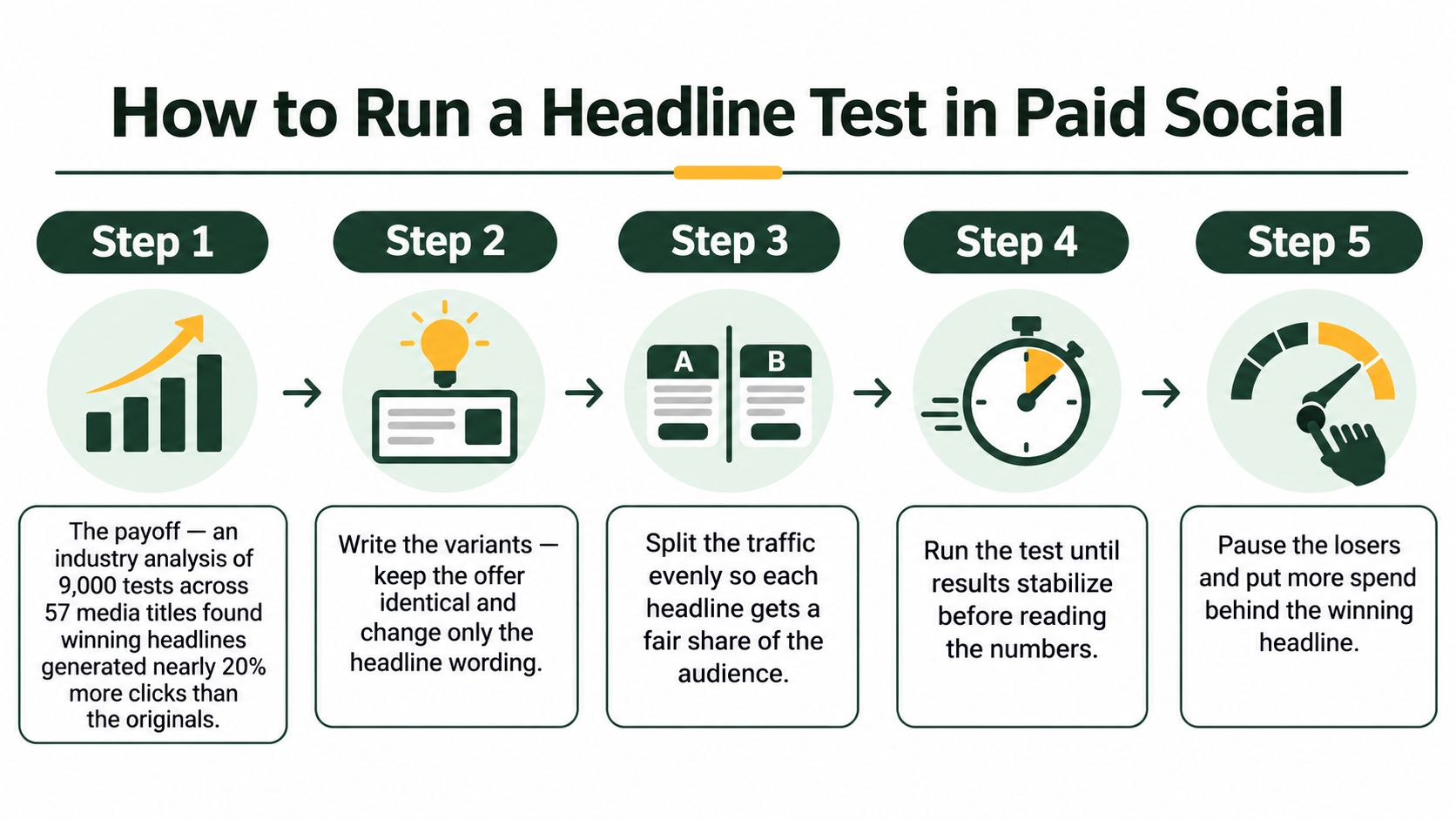
- Write the primary metric down before launch. Qualified click-through on the presell page, or add-to-cart rate. Pick one. If you choose after seeing results, you'll choose the metric that flatters the headline.
- Write three to five variants that differ in angle. Swapping "simple" for "easy" isn't a test, it's a coin flip. Change the promise structure: problem-led, benefit-led, proof-led.
- Hold everything else constant. Traffic source, audience, offer, page design and daily budget stay frozen while the headline moves. The common slip is swapping creative mid-flight and crediting the headline for the result.
- Set the run length and sample size in advance. Paid social is noisy in the first 48 hours. The most expensive mistake in this whole process is pausing a variant on the strength of one good Tuesday.
- Compare each variant against the original as control. Check that the gap is large enough to be meaningful rather than just the biggest number in the dashboard.
- Keep the winner, then write the next round from its angle. Winning tells you which promise your audience responds to, and the next test should push further into that territory rather than reset to a new guess.
If you'd rather watch the mechanics before building your own, this walkthrough covers setting up and reading a split test.
The test decides. The score only nominates.
Take the first variable from the ordered table, apply these six steps to that variable alone, and resist the urge to test angle, length and numerals at once. One clean answer beats three murky ones. Pair the test with a broader ad creative testing framework so the headline and the creative don't become competing explanations for the same lift.
Launching Headlines and Deciding When to Scale
The workflow that keeps this manageable runs in a fixed order, and the order is what stops a score from becoming a false comfort.
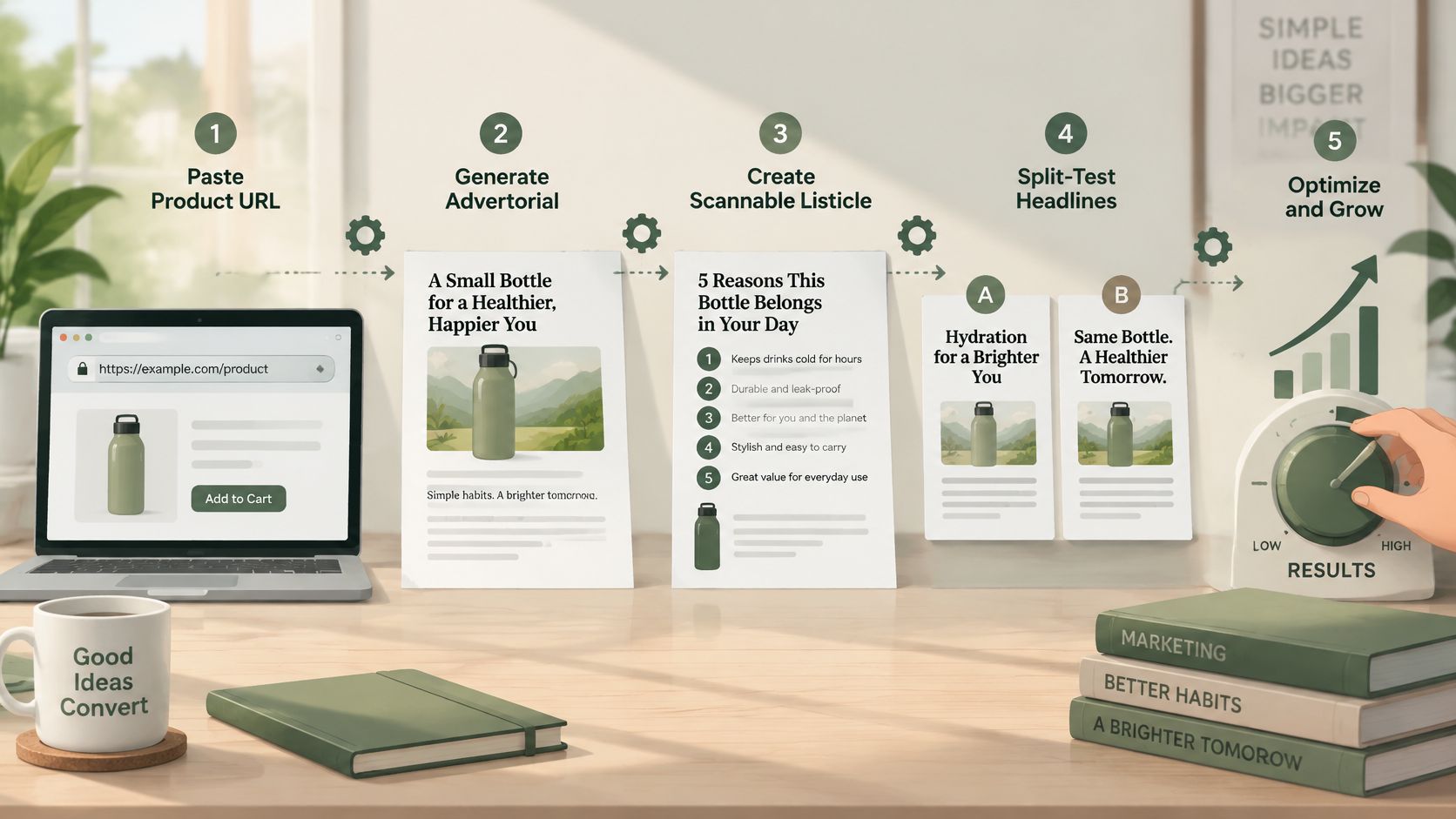
Generate the page from the product URL first. Choose the format by audience: a narrative advertorial for colder, skeptical buyers, and a scannable listicle for warmer, comparison-minded buyers. The format changes which headline patterns work, so settle it before you argue about wording.
Then shortlist with the analyzer. Paste two or three candidates into Landra's free Headline Analyzer and keep the ones with the fewest flags. It sits alongside the free Conversion Rate Calculator and Advertorial Compliance Checklist, and for cold traffic the compliance pass matters, because a headline promising a health or beauty outcome can break platform rules before it ever breaks a test.
Apply the winner in the editor. Every part of a generated page, including headlines, copy, images and structure, can be edited inline. Nothing about the score forces you to keep a line you don't like.
Duplicate the page for each variant. Each duplicate changes one headline while the offer and layout stay identical, so the headline is the only explanation for a difference. A page generates in about two minutes, which means a three-variant test costs you minutes rather than a creative brief.
Analyzer output is an input to that decision. The paid-social test picks the winner.
The pre-scale checklist
Six conditions should all be true before you move budget:
- The headline names the audience or the problem in the reader's own words. Not your internal product category.
- Every number and claim in the headline appears on the page with proof. Reviews, ingredient list, results timeline, guarantee.
- The ad creative makes the same promise as the headline. Message match starts in the feed, not on the page.
- Analyzer flags are either fixed or consciously accepted. Write down the reason for any you keep, so nobody re-litigates it in a month.
- The winner ran its full test window against the original as control. No early stops.
- Add-to-cart or purchase moved in the same direction as click-through. If clicks rose and carts fell, the headline oversold.
If no variant beats the control, don't scale. Pick the next variable from the ordered test table and run another round. A flat test isn't a failure, it's information about which promise doesn't land with this audience, and it costs far less than scaling a headline nobody has validated.
One action for this week: choose a live campaign, write three variants that differ in angle rather than synonym, and set the primary metric before anything launches.
Landra turns a product URL into an editable advertorial or listicle in about two minutes, then puts a free Headline Analyzer in front of your candidates so you can shortlist the ones worth spending test budget on. You can rewrite the headline inline, duplicate the page so each variant changes one thing, and publish to Shopify, a Landra URL or an HTML export. Start with one product and three headlines at Landra.